
Time: Jul 6 2026 Views: 7
INTRODUCTION
Industrial facilities discharge large amounts of thermal energy through flue gas, exhaust air, and process streams. Heat recovery systems are designed to capture this wasted energy and convert it into useful heat for water, steam, or process heating.
Understanding the principles behind heat recovery is essential for designing efficient, reliable, and corrosion-resistant systems.
PRINCIPLE 1 — TEMPERATURE DIFFERENCE DRIVES HEAT TRANSFER
All heat recovery systems are based on a simple rule:
Heat flows from high temperature to low temperature.
Flue gas typically exits industrial processes at temperatures between 120°C and 350°C. Heat exchangers transfer this energy to a lower-temperature medium such as water or air.
The greater the temperature difference, the higher the potential energy recovery.
PRINCIPLE 2 — HEAT TRANSFER SURFACE CONTROLS EFFICIENCY
The amount of heat recovered depends heavily on the available heat transfer surface area.
However, increasing surface area also introduces engineering challenges:
● Higher pressure drop
● Increased fouling risk
● Greater corrosion exposure
Therefore, heat exchanger design is always a balance between efficiency and long-term reliability.
PRINCIPLE 3 — CORROSION DEFINES THE REAL OPERATING LIMIT
In industrial flue gas systems, corrosion is often more limiting than thermal performance.
When flue gas temperature drops below the **acid dew point**, sulfur compounds condense into acidic liquids such as sulfuric acid.
This leads to:
● Rapid metal corrosion
● Reduced equipment lifespan
● Increased maintenance requirements
● Forced higher operating temperatures
As a result, many systems cannot fully utilize available waste heat.
PRINCIPLE 4 — MATERIAL SELECTION DEFINES SYSTEM PERFORMANCE
Different materials behave very differently under corrosive heat recovery conditions.
Stainless Steel
● High thermal conductivity
● Good structural strength
● Cost-effective
● Susceptible to acid dew-point corrosion
Fluoroplastic Materials
● Excellent corrosion resistance
● Low surface energy (anti-fouling)
● Limited mechanical strength
● Restricted installation conditions
Fluoroplastic-Steel Composite
● Combines corrosion resistance and structural strength
● Suitable for corrosive flue gas environments
● Enables lower temperature operation
● Supports long-term stable performance
PRINCIPLE 5 — SYSTEM DESIGN IS MORE IMPORTANT THAN COMPONENTS
Heat recovery performance is not determined by a single exchanger alone.
It depends on the entire system:
● Flue gas flow design
● Heat exchanger arrangement
● Pressure drop control
● Condensation management
● Corrosion protection strategy
A well-designed system can recover significantly more energy than a poorly designed one using identical equipment.
PRINCIPLE 6 — DEEP HEAT RECOVERY REQUIRES CORROSION CONTROL
The deeper the heat recovery, the closer the system operates to the acid dew point.
This creates a key engineering contradiction:
> Lower temperature improves efficiency
> But increases corrosion risk
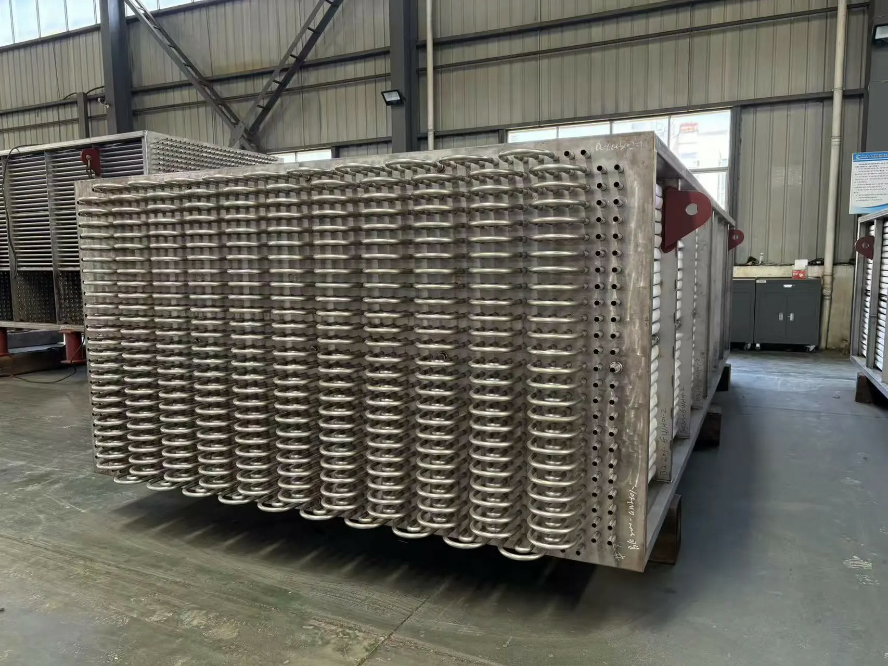
Advanced corrosion protection technologies, such as fluoroplastic-steel composite structures, allow safe operation in this critical zone.
KEY TAKEAWAY
Heat recovery is not only a thermal process — it is a balance between:
● Thermodynamics
● Material science
● Corrosion engineering
● System integration
True efficiency is achieved when all four are optimized together.
CONCLUSION
Effective heat recovery systems are not defined by how much heat they can initially capture, but by how reliably they can operate under corrosive, low-temperature conditions over long periods.
Understanding these principles is the foundation for designing high-performance industrial energy recovery systems.

@ 2025-2026 Langteng Machinery. All Rights Reserved.