
Time: Jul 6 2026 Views: 4
INTRODUCTION
Acid dew-point corrosion is one of the most critical limiting factors in low-temperature flue gas heat recovery systems.
It occurs when flue gas cools to a temperature where acidic vapors condense on heat transfer surfaces, leading to rapid material degradation and system failure if not properly controlled.
Understanding this phenomenon is essential for designing reliable and efficient heat recovery systems.
WHAT IS ACID DEW-POINT CORROSION?
Phase Transition of Corrosive Compounds
During combustion processes, flue gas contains sulfur compounds such as:
● sulfur dioxide (SO₂)
● sulfur trioxide (SO₃)
As the gas cools, these compounds react with moisture to form sulfuric acid vapor.
When the temperature drops below the **acid dew point**, this vapor condenses into liquid acid on metal surfaces.
This process is known as acid dew-point corrosion.
HOW IT OCCURS
Corrosion Formation Process
Step 1 — Combustion Gas Formation
Fuel combustion produces high-temperature flue gas containing sulfur compounds.
Step 2 — Cooling of Flue Gas
As heat is recovered, flue gas temperature decreases.
Step 3 — Acid Formation
SO₃ reacts with water vapor to form sulfuric acid (H₂SO₄).
Step 4 — Condensation on Surfaces
When temperature falls below the acid dew point, acid condenses on heat exchanger surfaces.
Step 5 — Material Corrosion
Acidic liquid aggressively attacks metallic surfaces, causing corrosion and material loss.
WHY IT IS CRITICAL IN HEAT RECOVERY SYSTEMS
The Efficiency vs Corrosion Trade-Off
Heat recovery systems aim to reduce flue gas temperature to improve energy efficiency.
However:
> Lower temperature increases heat recovery
> but also increases corrosion risk
This creates a fundamental engineering constraint in system design.
IMPACT ON INDUSTRIAL SYSTEMS
Consequences of Acid Dew-Point Corrosion
1. Equipment Degradation
Metal surfaces are progressively damaged by acidic attack.
2. Reduced Heat Transfer Efficiency
Corrosion and fouling reduce thermal performance over time.
3. Increased Maintenance Costs
Frequent inspection, repair, and replacement are required.
4. Operational Instability
Severe corrosion can lead to unplanned shutdowns.
5. Limited Heat Recovery Depth
Systems are forced to operate at higher exhaust temperatures to avoid corrosion.
KEY ENGINEERING CHALLENGE
Safe Heat Recovery Below the Acid Dew Point
The central engineering problem is:
> How to recover more heat without triggering corrosion failure.
Traditional metallic systems are limited by this boundary condition.
ENGINEERING SOLUTION APPROACH
Corrosion-Resistant Heat Transfer Surfaces
Modern solutions use advanced material systems such as:
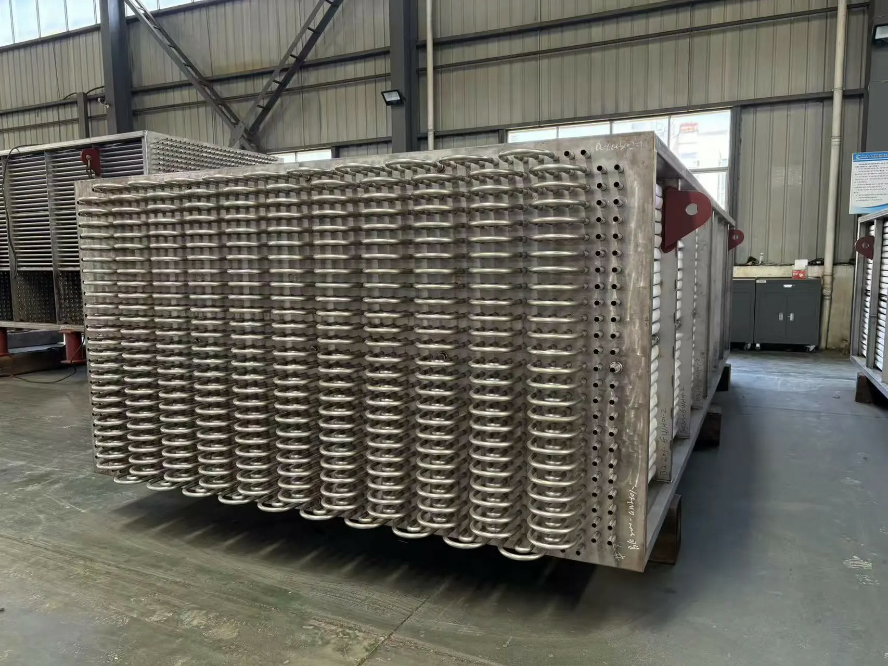
Fluoroplastic-Steel Composite Structures
● Fluoroplastic outer layer prevents acid contact
● Steel core provides mechanical strength
● Enables operation in corrosive low-temperature zones
This allows deeper heat recovery while maintaining long-term reliability.
KEY INSIGHT
Acid Dew Point Defines System Limits
The acid dew point is not just a temperature value.
It is a **design boundary** that determines:
● maximum achievable heat recovery
● material selection
● system configuration
● lifecycle performance
APPLICATION AREAS
Where Acid Dew-Point Corrosion Is Critical
● Power generation flue gas systems
● Chemical processing exhaust systems
● Metallurgy and smelting plants
● Sulfuric acid production systems
● Waste acid recovery facilities
● Environmental treatment systems
CONCLUSION
Acid dew-point corrosion is one of the most important engineering challenges in low-temperature heat recovery systems.
It directly determines:
● how much energy can be recovered
● how long equipment can operate
● what materials must be used
Effective system design must address corrosion at the structural level, not as an afterthought.
CTA
Want to design a heat recovery system that operates safely below the acid dew point?
Discuss your flue gas conditions with our engineering team to identify the optimal solution.

@ 2025-2026 Langteng Machinery. All Rights Reserved.