
Time: Jul 6 2026 Views: 4
NTRODUCTION
Deep heat recovery technology refers to the engineering approach of extracting additional thermal energy from flue gas by reducing its outlet temperature beyond conventional recovery limits.
Unlike traditional heat recovery systems that prioritize equipment safety over energy utilization, deep heat recovery focuses on:
> Maximizing energy recovery while maintaining long-term system reliability under corrosive conditions.
THE CORE CHALLENGE
The Efficiency–Corrosion Trade-Off
In industrial flue gas systems, improving efficiency requires lowering exhaust temperature.
However, as temperature decreases:
● Acid condensation begins to form
● Corrosion risk increases sharply
● Equipment lifespan is reduced
● System reliability becomes unstable
This creates a fundamental engineering limitation:
> Higher efficiency increases corrosion risk.
WHAT IS DEEP HEAT RECOVERY?
Beyond Conventional Temperature Limits
Deep heat recovery is the process of safely operating below traditional flue gas temperature limits to extract additional usable energy.
It enables:
● Lower flue gas outlet temperatures
● Higher total energy recovery
● Improved overall system efficiency
● Better lifecycle economics
ENGINEERING PRINCIPLE
Controlled Operation Near the Acid Dew Point
The acid dew point defines the boundary where sulfuric acid begins to condense in flue gas systems.
Traditional systems avoid this region.
Deep heat recovery systems are engineered to:
● Approach the acid dew point safely
● Control condensation risk
● Maintain stable heat transfer surfaces
● Prevent corrosion-induced failure
TECHNOLOGY BARRIER
Why Conventional Systems Cannot Go Deeper
Most traditional heat exchangers are limited by:
● Stainless steel corrosion sensitivity
● Fouling and scaling at low temperatures
● Structural degradation under acidic conditions
● Maintenance and downtime constraints
As a result, they operate at higher-than-optimal exhaust temperatures.
ENGINEERING SOLUTION
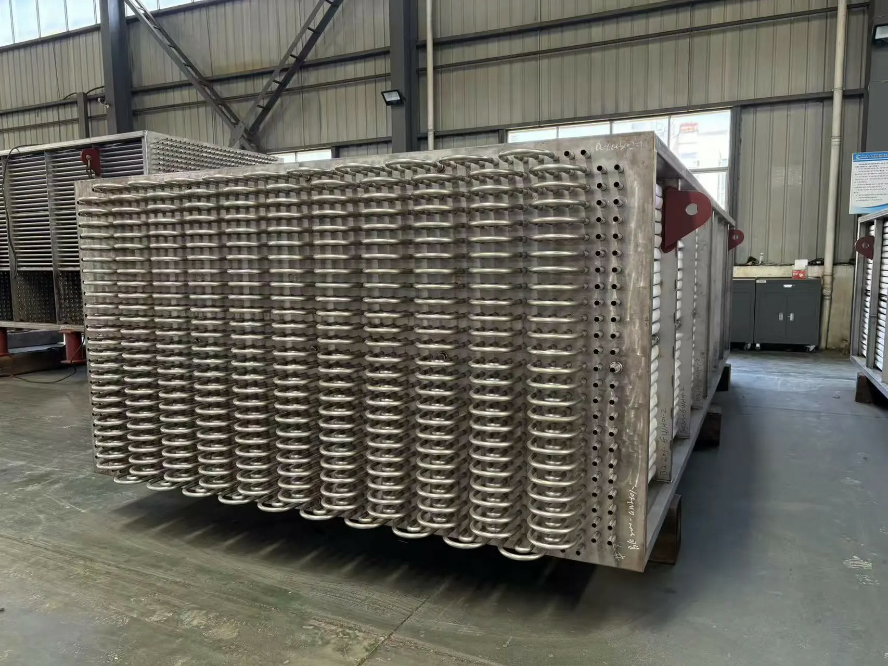
Fluoroplastic-Steel Composite Heat Transfer Technology
Deep heat recovery is made possible through advanced composite structure design:
Fluoroplastic Outer Layer
● Prevents direct acid contact
● Resists chemical corrosion
● Reduces fouling and scaling
Steel Structural Core
● Provides mechanical strength
● Ensures pressure resistance
● Supports industrial-scale operation
Combined Effect
This structure enables:
> Safe heat recovery below traditional corrosion limits.
SYSTEM PERFORMANCE ADVANTAGES
Why Deep Heat Recovery Is Effective
1. Lower Exhaust Temperature
More thermal energy is extracted from flue gas streams.
2. Higher Energy Utilization
Previously wasted heat is converted into usable energy.
3. Stable Corrosion Control
Protective surfaces reduce acid attack risk.
4. Extended Equipment Lifecycle
Composite structure improves long-term durability.
5. Improved Economic Efficiency
Higher energy recovery reduces overall operating cost.
APPLICATION AREAS
Where Deep Heat Recovery Is Used
● Power generation flue gas systems
● Metallurgy and smelting processes
● Chemical processing plants
● Sulfuric acid production systems
● Environmental treatment facilities
● Waste acid recovery systems
KEY DESIGN CONSIDERATION
System-Level Engineering Is Essential
Deep heat recovery cannot be achieved by equipment alone.
It requires coordinated design of:
● flue gas flow management
● heat exchanger configuration
● corrosion protection strategy
● pressure drop control
● condensation behavior
System integration determines actual performance.
KEY INSIGHT
Efficiency Is Limited by Corrosion, Not Energy Availability
Industrial flue gas still contains significant recoverable energy.
The limitation is not thermal potential — but material and corrosion constraints.
Deep heat recovery technology removes part of this limitation through engineered corrosion resistance.
CONCLUSION
Deep heat recovery technology enables industrial systems to achieve higher energy efficiency by safely operating closer to critical condensation and corrosion boundaries.
By integrating corrosion protection with thermal engineering, it is possible to:
● recover more waste heat
● reduce energy consumption
● improve system stability
● extend equipment life

@ 2025-2026 Langteng Machinery. All Rights Reserved.