
Time: Oct 25 2026 Views: 17
Learn how flue gas condensers recover industrial waste heat, how flue gas condensation corrosion occurs, and how fluoroplastic-steel technology protects heat exchangers.
Primary Keyword: Flue Gas Condenser
Secondary Keywords: Flue Gas Condensation · Flue Gas Condensing Heat Exchanger · Flue Gas Condensation Corrosion
Industrial combustion processes generate large volumes of flue gas containing valuable thermal energy. In many facilities, this energy is discharged through exhaust stacks, even when it could be recovered to improve overall system efficiency.
Conventional heat recovery equipment can capture part of this energy. However, further cooling may introduce a significant engineering challenge: flue gas condensation corrosion.
A flue gas condenser is designed to recover heat from exhaust gases under condensing conditions. When properly engineered, it can recover both sensible heat and part of the latent heat associated with vapor condensation.
For industrial processes involving corrosive flue gas, the selection of heat exchanger materials becomes particularly important.
This article explains how flue gas condensation works, the operating principles of a flue gas condensing heat exchanger, the causes of condensation corrosion, and the role of fluoroplastic-steel composite technology in reliable low-temperature heat recovery.
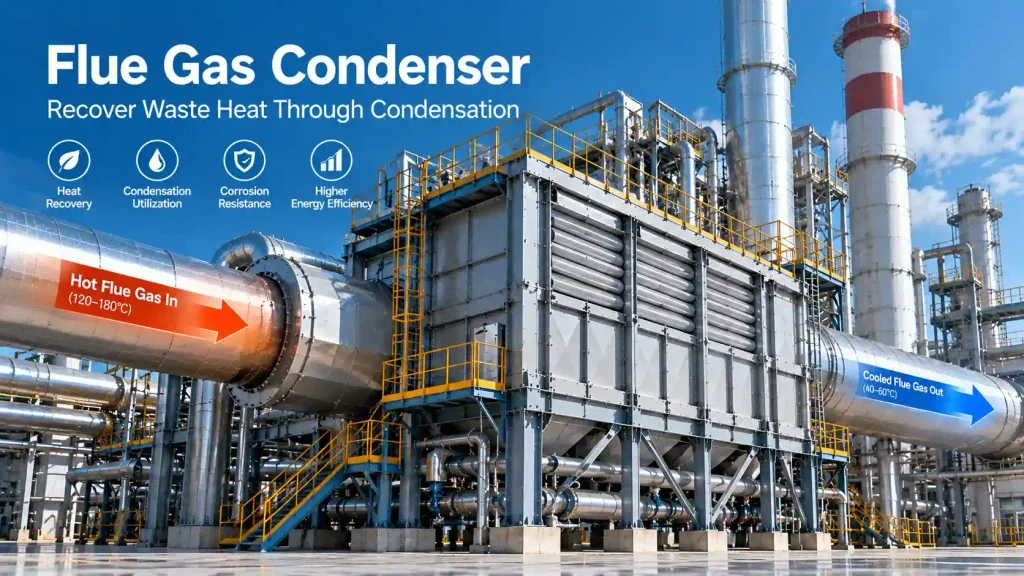
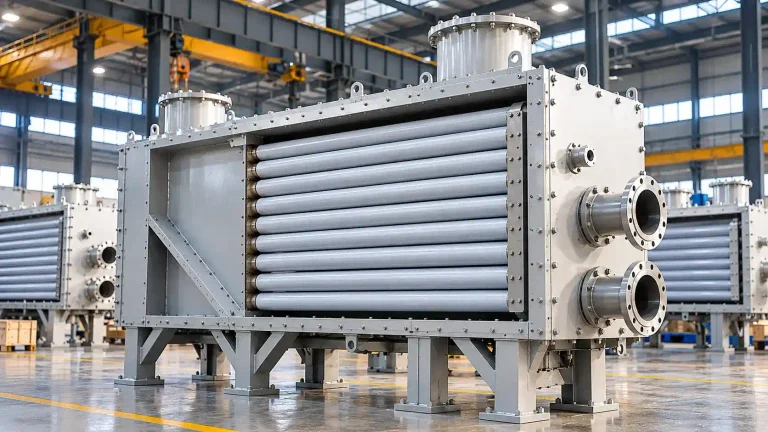
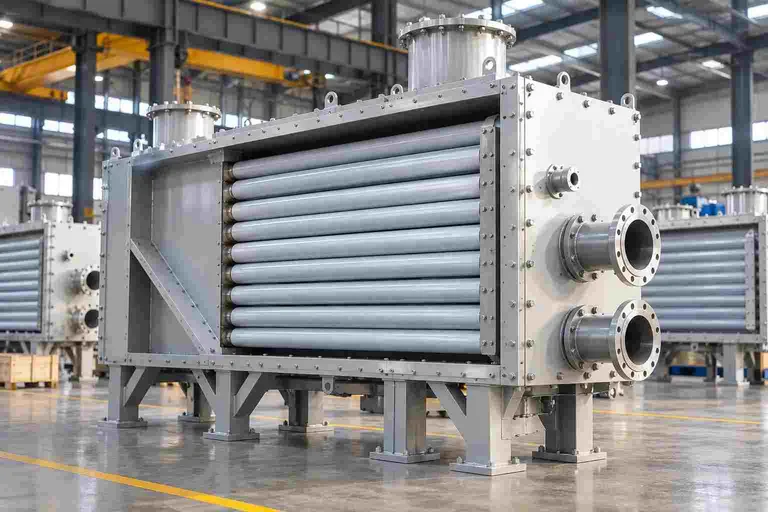
A flue gas condenser is an industrial heat exchanger used to cool exhaust gases and recover thermal energy, particularly when condensation occurs within the heat recovery process.
Flue gas from boilers, furnaces, and other combustion equipment often contains water vapor along with carbon dioxide, nitrogen, oxygen, and varying concentrations of sulfur-containing or other potentially corrosive compounds.
As the gas passes through a condenser, heat is transferred to a colder medium, typically water.
Depending on operating conditions, two types of heat recovery may occur:
Sensible Heat Recovery
The flue gas temperature decreases without necessarily causing water vapor to condense. Thermal energy is transferred from the hot gas to the circulating water.
Latent Heat Recovery
When the relevant heat-transfer surfaces are sufficiently cold, water vapor in the flue gas begins to condense. This releases latent heat, which can also be transferred to the water circuit.
Recovering latent heat can increase the amount of usable energy extracted from exhaust gases.
However, the achievable recovery depends on fuel composition, flue gas humidity, gas temperature, cooling-water temperature, and heat exchanger design.
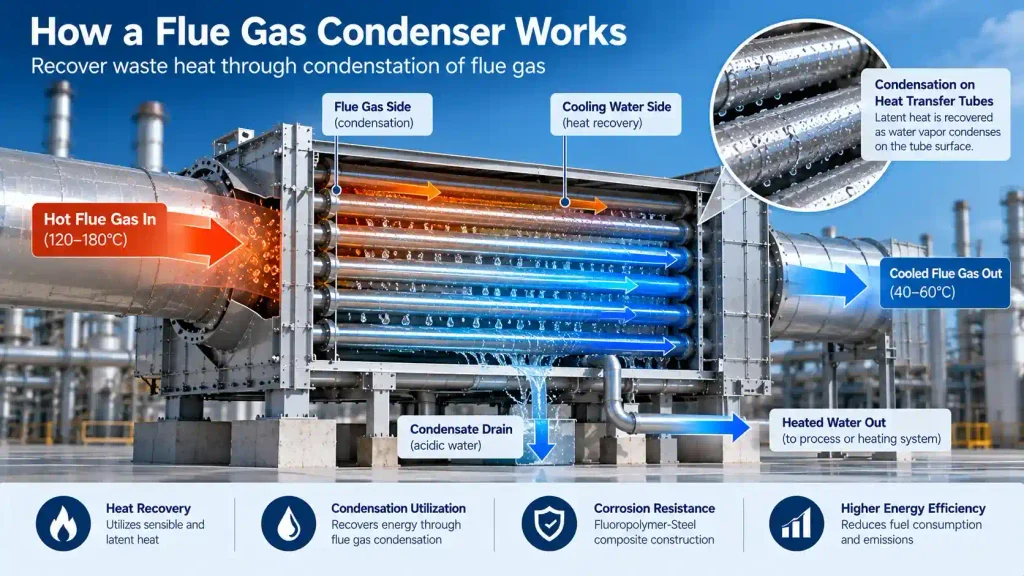
Flue gas condensation occurs when condensable components in exhaust gas reach conditions at which they change from vapor to liquid.
The process is influenced by the partial pressure of each condensable component and the temperature of the heat-transfer surfaces.
In a typical condensing heat recovery system, the process follows several stages.
Exhaust gas from an industrial combustion process enters the heat recovery equipment through an inlet duct.
The gas may already have passed through conventional heat recovery equipment, depending on the plant configuration.
The flue gas flows across heat-transfer surfaces while cooling water or another suitable liquid circulates through a separate flow passage.
The temperature difference drives heat transfer between the two media.
As the gas and heat-transfer surfaces cool, condensable components may reach their dew points.
Water vapor condensation releases latent heat, while certain acidic species may condense under different temperature conditions.
Importantly, the water dew point and acid dew point are not necessarily the same.
The heated water can be used for applications such as:
The actual application depends on the available temperature levels, water quality, and system configuration.
When liquid condensate forms, it must be collected and discharged through an appropriately designed drainage system.
Where acidic condensate is expected, corrosion-resistant drainage materials and suitable condensate treatment may be required.
Reliable condensate management is essential for long-term operation.
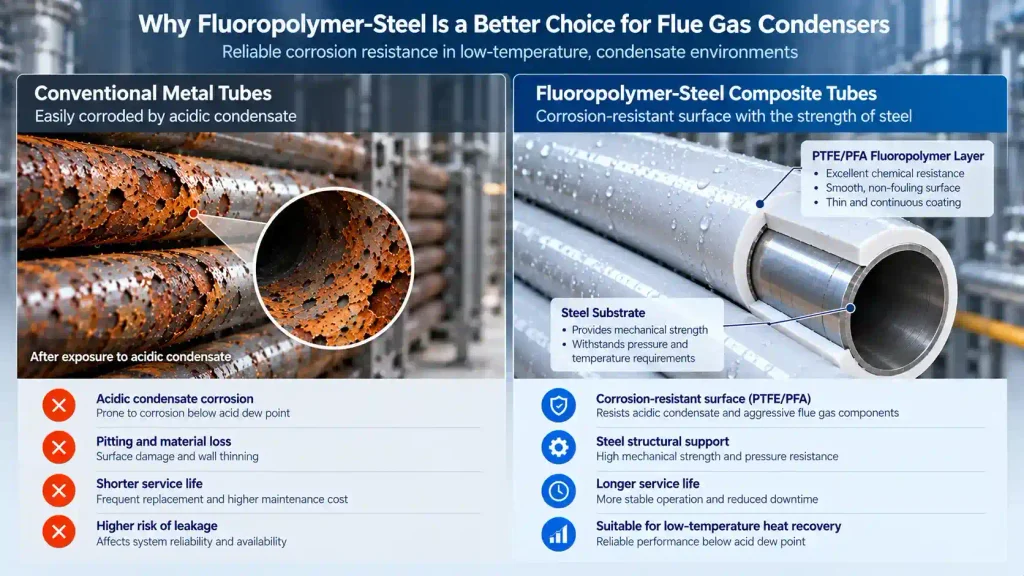
Although condensation can increase heat recovery, it can also expose equipment to aggressive chemical environments.
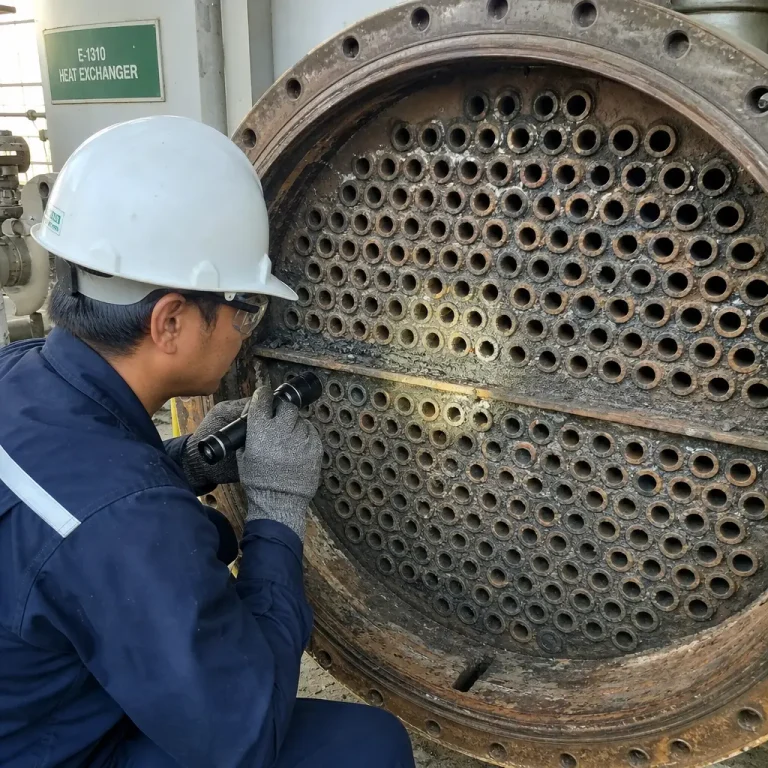
Flue gas condensation corrosion occurs when condensate containing corrosive substances attacks susceptible equipment materials.
This is especially relevant in processes involving sulfur-bearing fuels or other sources of acidic flue gas components.
Sulfur-containing compounds in flue gas may contribute to the formation of sulfuric acid vapor.
When heat-transfer surfaces fall below the relevant acid dew point, acidic condensate can form on exposed surfaces.
Depending on the flue gas composition, acid condensation may occur at temperatures above the water vapor dew point.
This means corrosion can begin even before substantial water condensation takes place.
In inadequately protected equipment, condensation corrosion can contribute to:
The severity depends on the condensate chemistry, surface temperature, material selection, operating cycles, and other site-specific conditions.
Traditional carbon-steel heat exchangers provide good mechanical strength and thermal conductivity but may be vulnerable to acidic condensate.
Stainless steel can improve corrosion resistance in some applications, but its suitability depends on the actual acid composition, concentration, temperature, and contaminants.
Consequently, material selection should be based on the specific operating environment rather than assuming that a particular metal grade is universally corrosion-resistant.
For demanding low-temperature flue gas applications, alternative corrosion-protection technologies may be appropriate.
A flue gas condensing heat exchanger is the heat-transfer equipment that enables energy recovery under flue gas condensing conditions.
It generally incorporates several essential functional elements:
Gas Flow Passages
These direct flue gas through the heat exchanger while controlling flow distribution and pressure losses.
Heat-Transfer Surfaces
These separate the flue gas from the cooling medium and provide the surface area required for energy transfer.
Cooling-Water Circuit
This carries recovered thermal energy to a useful heating process.
Condensate Collection and Drainage
These manage liquid formed during operation and help prevent unwanted accumulation.
Corrosion Protection
This protects surfaces exposed to acidic condensate and other aggressive compounds.
A successful design must balance thermal performance, gas-side pressure drop, corrosion resistance, drainage, mechanical integrity, and maintenance accessibility.
For this reason, selecting a condensing heat exchanger involves more than calculating the required heat-transfer area.
Langteng develops fluoroplastic-steel composite heat recovery equipment for industrial flue gas applications where corrosion resistance and structural reliability are important.
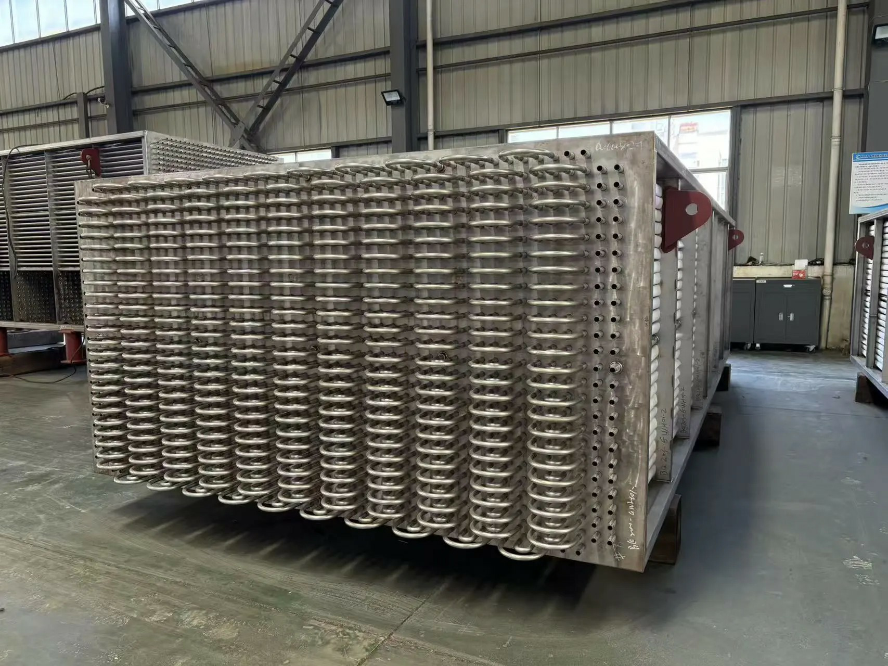
The technology combines a steel supporting structure with a fluoroplastic protective layer.
In Langteng's composite tube concept, the steel provides mechanical support while the fluoroplastic layer protects the gas-exposed surface.
PTFE and PFA are fluoropolymers recognized for their chemical resistance in many aggressive environments.
The suitability of a particular fluoropolymer must nevertheless be confirmed against the actual operating temperature, pressure, chemical composition, and mechanical conditions.
The fluoroplastic layer acts as a barrier between the corrosive flue gas environment and the underlying steel.
This can help reduce direct exposure of the metal to acidic condensate when the protective layer is correctly selected, manufactured, and maintained.
The steel substrate provides mechanical strength and dimensional stability.
This composite approach seeks to combine corrosion protection with the structural capabilities needed in industrial heat recovery equipment.
Because fluoroplastics generally have lower thermal conductivity than metals, the protective layer introduces additional thermal resistance.
The thickness of the layer, tube geometry, thermal contact, flow conditions, and heat-transfer area must therefore be considered carefully.
A properly engineered composite design seeks to balance corrosion protection with acceptable thermal performance.
The service life of a fluoroplastic-steel condenser depends on more than chemical resistance alone.
Important factors include coating integrity, thermal cycling, differential expansion, erosion, fouling, drainage, operating temperature, and installation quality.
Material qualification and operating-condition analysis are essential to reliable system performance.
A fluoroplastic-steel flue gas condenser follows the same fundamental heat-transfer principles as other condensing heat exchangers, while incorporating corrosion-resistant surfaces.
In a typical configuration, hot flue gas flows over the protected external surfaces of composite heat-transfer tubes.
A colder liquid circulates through the internal passages.
Thermal energy moves from the flue gas, through the composite tube wall, and into the liquid.
As the flue gas cools, condensation may occur when the relevant dew-point conditions are reached.
The protective fluoroplastic surface helps separate the steel substrate from corrosive condensate.
The recovered heat is carried away by the circulating liquid and can be integrated into the plant's heating system.
For applications involving acidic condensate, the equipment must also include appropriate condensate collection, drainage, and corrosion-resistant interfaces.
The precise configuration should be selected according to flue gas chemistry, inlet temperature, moisture content, gas flow rate, cooling-medium conditions, and the required thermal duty.
Flue gas condensing heat exchangers can be considered across multiple industries where recoverable exhaust heat and suitable cooling demands exist.
Boiler exhaust streams may provide opportunities for additional low-temperature heat recovery.
Potential uses include heating compatible water circuits or recovering energy for other plant requirements.
Chemical plants may generate flue gas containing corrosive compounds.
In these environments, material compatibility and corrosion protection can be critical to equipment selection.
Industrial furnaces and associated processes generate exhaust heat.
Where the flue gas contains corrosive constituents, specialized heat recovery equipment may be necessary.
Condensing heat recovery can be considered for suitable boiler exhaust streams, particularly when a sufficiently cool water return or another low-temperature heat sink is available.
Some flue gas treatment processes involve moisture, acidic compounds, and low-temperature operating conditions.
Heat recovery may be integrated where process conditions and the overall treatment system permit.
In every application, technical feasibility depends on site-specific thermal and chemical conditions.
Before specifying a flue gas condenser, plant engineers and equipment suppliers should establish the operating requirements.
Flue Gas Conditions
Determine gas flow rate, inlet temperature, moisture content, pressure, and relevant chemical constituents.
Dew Point and Condensation Behavior
Evaluate water and acid dew points to understand when and where condensation may occur.
Cooling-Medium Requirements
Identify inlet and outlet temperatures, flow rate, pressure, and water quality.
Required Heat Recovery Duty
Calculate the recoverable energy and confirm that the plant has a suitable use for the recovered heat.
Corrosion Resistance
Evaluate material compatibility with expected condensate chemistry and operating conditions.
Pressure Drop
Assess the allowable gas-side pressure loss and its effect on the existing draft or fan system.
Installation and Maintenance
Consider equipment dimensions, access, drainage, cleaning requirements, and integration with existing ductwork.
These parameters help determine whether a condensing heat recovery system is technically and economically appropriate.
The objective of a flue gas condenser is not simply to reduce exhaust temperature as much as possible.
An effective system must recover useful heat while maintaining acceptable pressure drop, corrosion protection, condensate management, and operating reliability.
For corrosive flue gas applications, this requires coordinated decisions about heat-transfer materials, surface temperatures, equipment geometry, and integration with the existing process.
Langteng's fluoroplastic-steel composite technology is intended to address the material challenges associated with low-temperature industrial flue gas heat recovery.
By combining corrosion-resistant surface protection with a steel supporting structure, the technology provides an engineering option for applications where conventional metallic surfaces may face unacceptable corrosion risks.
Flue gas condensation offers opportunities to recover additional energy from industrial exhaust streams, including latent heat when water vapor condensation occurs.
However, the same cooling process can create corrosive conditions that threaten conventional heat recovery equipment.
Understanding flue gas condensation corrosion is therefore essential when selecting a flue gas condensing heat exchanger.
A properly designed flue gas condenser must address thermal performance, condensate chemistry, material compatibility, pressure drop, and system integration.
For demanding industrial applications, fluoroplastic-steel composite technology offers a corrosion-protection approach that can support reliable low-temperature heat recovery when appropriately engineered for the operating environment.
Looking for a corrosion-resistant flue gas condenser?
Langteng provides fluoroplastic-steel heat recovery equipment for industrial flue gas applications. Contact our engineering team to discuss your flue gas conditions, heat recovery objectives, and equipment requirements.

@ 2025-2026 Langteng Machinery. All Rights Reserved.