
Time: Oct 27 2026 Views: 17
Industrial boilers, furnaces, and chemical processing facilities discharge significant amounts of thermal energy through their exhaust systems. Recovering this energy can reduce fuel consumption and improve overall plant efficiency.
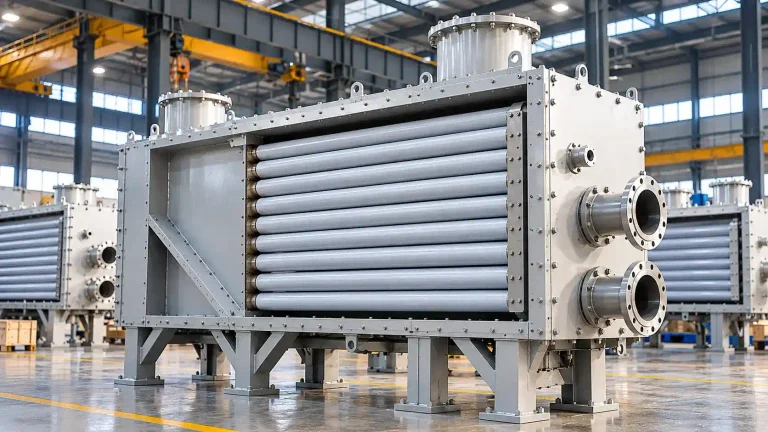
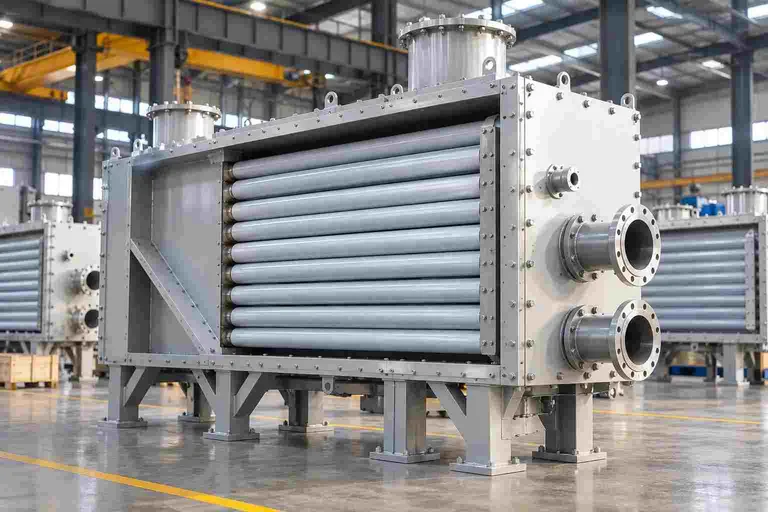
An air preheater for flue gas heat recovery captures heat from exhaust gases and transfers it to incoming combustion air or another process air stream.
The concept is straightforward. The engineering challenge is not.
As more heat is extracted, flue gas temperatures decrease, potentially exposing heat-transfer surfaces to acid dew point corrosion, fouling, and premature failure.
For facilities processing sulfur-containing fuels or corrosive exhaust gases, conventional metallic air preheaters may therefore face limitations.
This article examines how industrial air preheaters work, compares different heat recovery technologies, and explains how Langteng's fluoropolymer-steel composite air preheaters can address corrosion challenges in demanding applications.
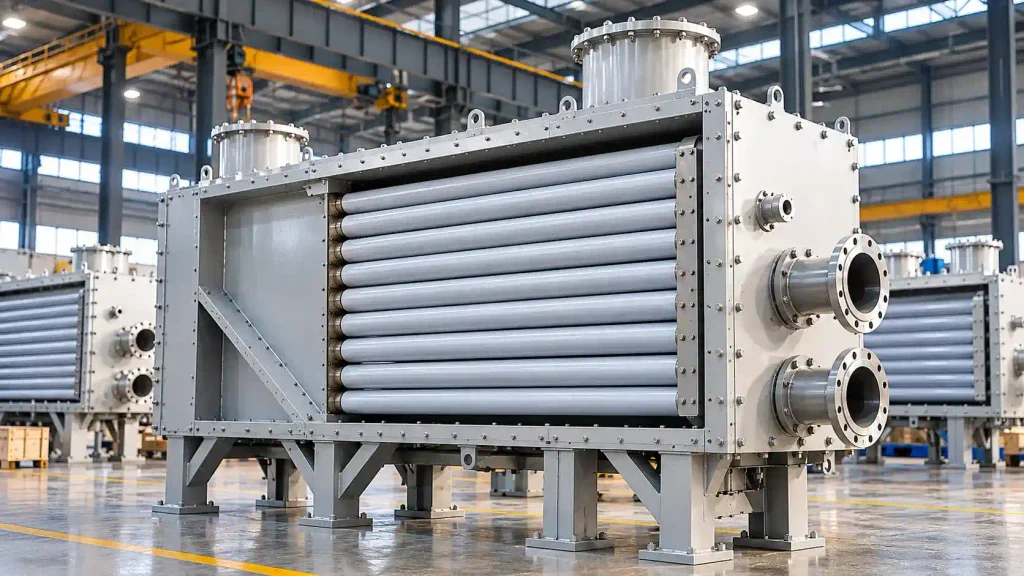
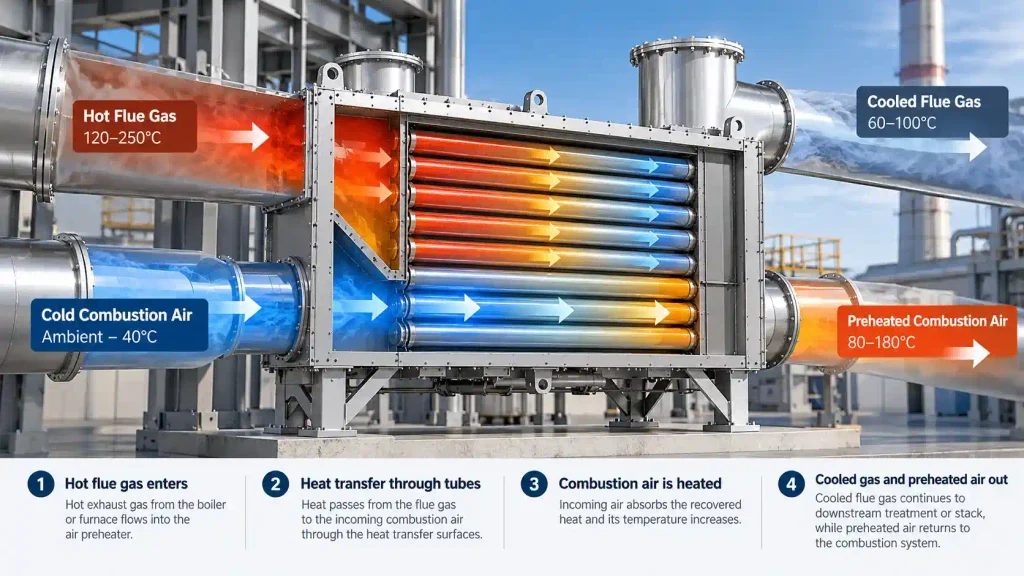
An industrial air preheater transfers thermal energy from hot exhaust gas to a cooler air stream before that air enters a combustion or industrial process.
In a typical boiler application, the system operates through four stages:
By increasing combustion air temperature, the system reduces the additional fuel energy needed to achieve the required process temperature.
For industrial drying applications, recovered heat may instead be used to preheat fresh process air.
The main benefit is reduced fuel consumption for a given useful heat output.
However, the actual improvement depends on operating conditions, including:
An air preheater should therefore be evaluated as part of the complete combustion system rather than as an isolated heat exchanger.
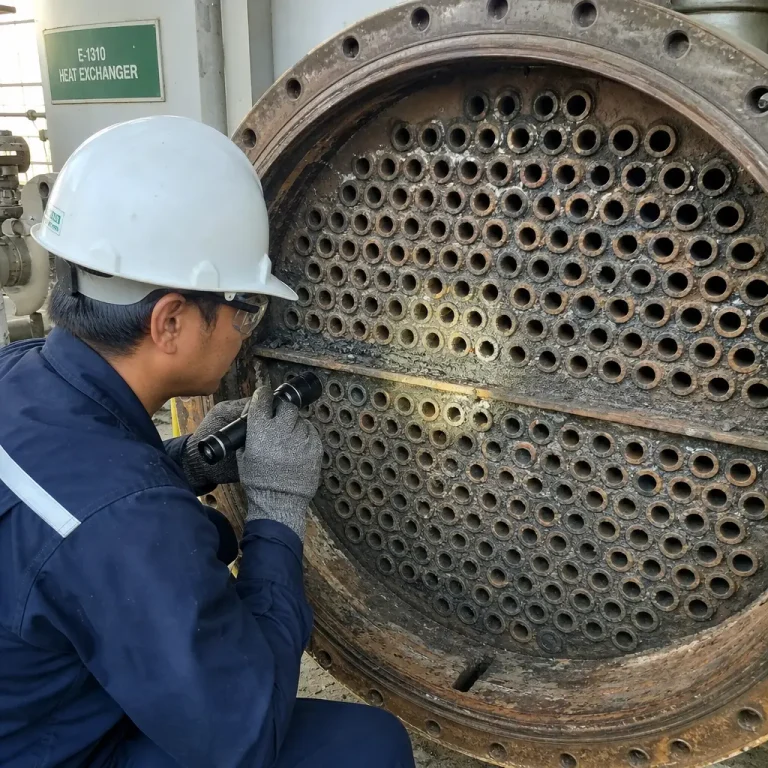
The most important limitation in many industrial flue gas heat recovery applications is low-temperature corrosion.
When sulfur-containing fuels are burned, sulfur oxides may be present in the exhaust gas. Under suitable conditions, sulfur trioxide and water vapor contribute to sulfuric acid formation.
If the heat-transfer surface temperature falls below the relevant acid dew point, acidic condensate may form.
This can attack unprotected metallic surfaces.
The cold end of an air preheater is where relatively cool incoming air meets flue gas that has already lost much of its thermal energy.
Local surface temperatures may be considerably lower than the measured bulk flue gas temperature.
As a result, corrosion can occur even when the average outlet gas temperature appears acceptable.
Corrosion products can also combine with ash or other deposits, increasing fouling and restricting flow passages.
Over time, these conditions may cause:
This creates an engineering conflict: recovering more heat generally requires lower temperatures, but lower surface temperatures may increase corrosion risk.
Industrial air preheaters use different heat-transfer structures and materials.
The most appropriate technology depends on temperature, corrosion potential, equipment size, maintenance requirements, and project economics.
Carbon steel tubular air preheaters are widely used because of their mechanical strength, established manufacturing processes, and relatively economical construction.
They are often suitable for applications where corrosive condensation can be avoided.
Advantages
Limitations
For relatively clean, non-condensing applications, carbon steel may remain the most economical solution.
Stainless steel provides improved corrosion resistance in certain industrial environments.
It can be suitable where the process conditions justify the additional material cost.
However, stainless steel is not universally resistant to every acidic condensate.
Performance depends on alloy grade, temperature, acid concentration, chloride content, and other chemical conditions.
Advantages
Limitations
The correct stainless steel grade must be selected through a detailed chemical compatibility assessment.
Rotary air preheaters use a rotating heat-storage matrix that alternately contacts hot flue gas and incoming air.
They are commonly used in large industrial boilers and power plants.
Advantages
Limitations
Rotary systems remain a strong option for many large-scale applications, particularly when their operating conditions and maintenance requirements are well controlled.
Polymer-based heat exchangers provide an alternative approach for corrosive exhaust environments.
Their primary advantage is the chemical resistance of appropriately selected polymer surfaces.
However, polymer materials generally have lower thermal conductivity and different mechanical limitations compared with metals.
The equipment design must account for temperature limits, pressure requirements, structural support, and heat-transfer area.
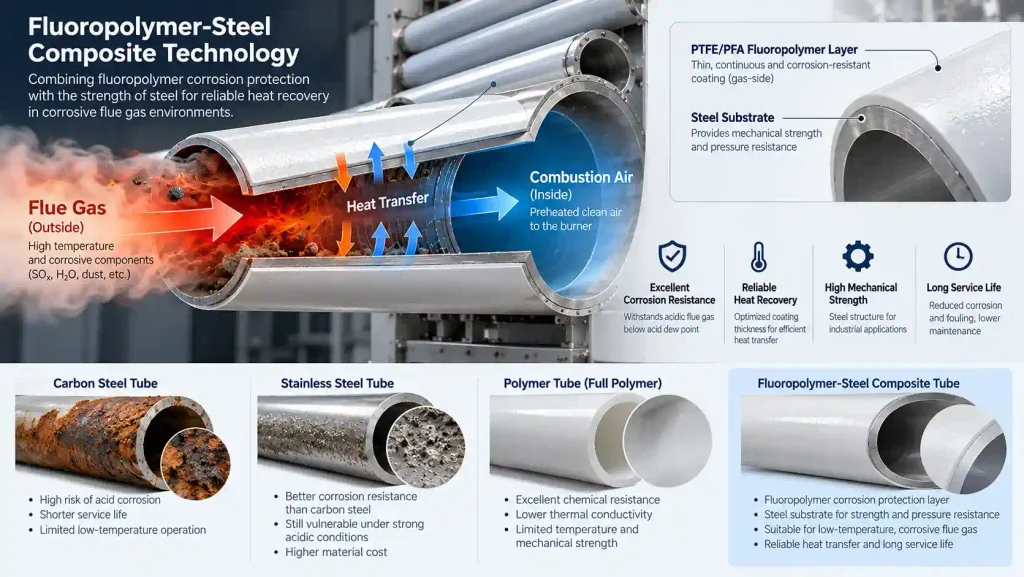
For applications where conventional metal surfaces face unacceptable corrosion risks, Langteng offers a different engineering approach.
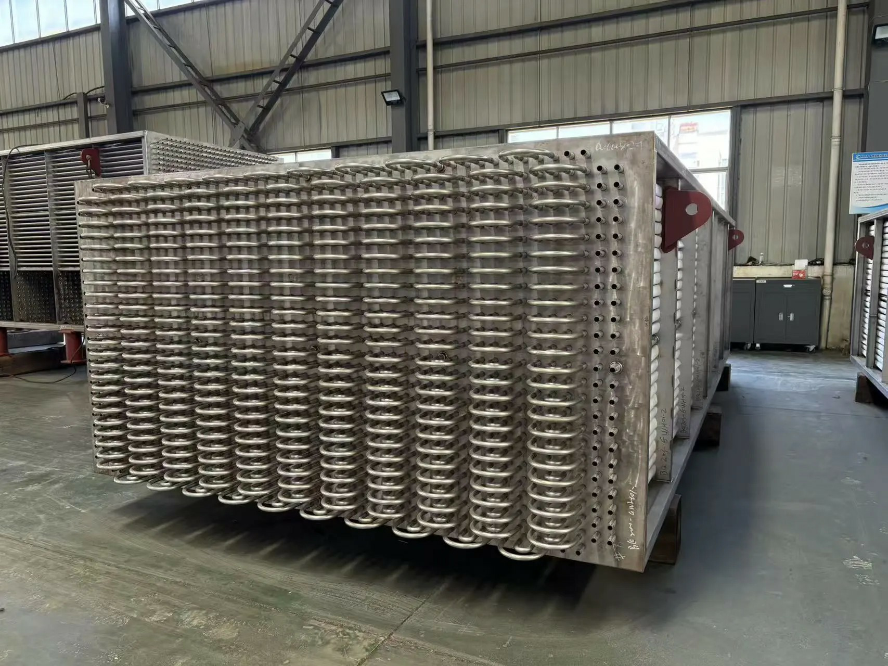
Our fluoropolymer-steel composite air preheater combines a steel supporting structure with a thin fluoropolymer corrosion-protection layer.
The objective is to combine the mechanical advantages of steel with the chemical resistance of selected fluoropolymer materials.
The gas-exposed surfaces are protected by a fluoropolymer layer designed to reduce direct contact between corrosive flue gas constituents and the underlying steel.
Materials such as PTFE and PFA offer chemical resistance in many aggressive industrial environments.
Material suitability must still be confirmed for the actual gas composition, temperature, pressure, and operating conditions.
The steel substrate provides mechanical support and dimensional stability.
This allows the composite structure to be engineered for industrial heat recovery duties where an unsupported polymer structure may be less suitable.
Fluoropolymers have lower thermal conductivity than steel.
Consequently, adding a protective layer introduces thermal resistance.
Langteng's engineering approach therefore considers protective-layer thickness, tube geometry, available surface area, flow distribution, and operating temperatures together.
The goal is not to claim that fluoropolymer conducts heat better than metal. It does not.
Instead, the objective is to achieve useful heat recovery while providing corrosion protection under operating conditions that may limit conventional metallic equipment.
Industrial flue gas conditions vary considerably.
Our air preheater solutions can be engineered around the required heat duty, available installation space, gas composition, allowable pressure drop, and air temperature requirements.
This application-specific approach is particularly important for existing plants considering a heat recovery retrofit.
The following comparison summarizes the principal engineering trade-offs.
| Technology | Main Strength | Main Limitation | Typical Suitability |
| Carbon Steel Tubular | Cost and strength | Acid corrosion | Conventional non-condensing duties |
| Stainless Steel | Selected corrosion resistance | Alloy-dependent compatibility and cost | Moderately corrosive duties |
| Rotary Regenerative | Compact large-duty recovery | Leakage, fouling, moving parts | Large boilers and power plants |
| Polymer-Based | Chemical resistance | Temperature and structural limits | Suitable low-temperature corrosive gases |
| Fluoropolymer-Steel Composite | Protected surface with steel support | Added thermal resistance and coating integrity requirements | Corrosive flue gas heat recovery |
No single air preheater technology is ideal for every industrial application.
For high-temperature, non-corrosive exhaust streams, conventional metallic equipment may provide better economic performance.
For large utility boilers, rotary regenerative equipment may offer practical advantages.
For low-temperature corrosive exhaust streams, corrosion-resistant polymer or composite technologies may enable additional heat recovery that would otherwise be difficult to achieve reliably.
The final decision should be based on engineering calculations and lifecycle cost rather than material claims alone.
Chemical plants may generate exhaust gases containing sulfur compounds, acidic vapors, or other corrosive constituents.
Corrosion-resistant air preheaters can be considered when recovered heat is suitable for combustion or process air heating.
Industrial furnaces generate significant exhaust heat.
Depending on fuel, raw materials, and process conditions, these gases may contain corrosive components that influence heat exchanger selection.
Boilers operating with sulfur-containing fuels may experience cold-end corrosion when exhaust temperatures are reduced.
A corrosion-resistant air preheater may provide an alternative to designs that rely entirely on maintaining metal temperatures above the acid dew point.
Dryers may discharge warm exhaust air containing moisture or chemically aggressive constituents.
Where sufficient temperature difference exists, heat can be recovered to preheat incoming process air.
As a manufacturer, Langteng recommends establishing the actual process conditions before selecting equipment materials or estimating energy savings.
The essential information includes:
Flue Gas Conditions
Flow rate, inlet temperature, pressure, moisture content, dust loading, and relevant corrosive constituents.
Air-Side Requirements
Incoming air temperature, required outlet temperature, flow rate, and allowable pressure loss.
Corrosion Assessment
Expected acid dew point, condensate chemistry, operating cycles, and material compatibility.
Thermal Performance
Required heat recovery duty, temperature approach, and expected operating hours.
Mechanical and Installation Requirements
Available space, duct connections, structural support, access for maintenance, and applicable design standards.
Operating Economics
Equipment cost, installation cost, fan energy consumption, cleaning requirements, and anticipated maintenance expenditure.
These factors allow the manufacturer and plant engineer to evaluate the most appropriate technology.
The lowest-priced air preheater is not always the most economical over its operating life.
A complete assessment should consider:
A corrosion-resistant composite heat exchanger may justify a higher initial investment when corrosion-related failures or operating restrictions create substantial lifecycle costs.
However, the financial benefit must be calculated using actual site conditions and realistic maintenance assumptions.
For some applications, conventional metal equipment will remain the better choice.
For others, corrosion resistance may be essential to achieving the intended heat recovery duty.
Selecting an air preheater for flue gas heat recovery requires more than choosing a heat exchanger from a product catalog.
The equipment must be designed around the interaction between thermal performance, gas chemistry, material compatibility, pressure drop, and plant operating conditions.
Langteng manufactures fluoropolymer-steel composite heat recovery equipment for demanding industrial applications.
Our engineering approach focuses on corrosion-resistant heat-transfer surfaces, customized equipment design, and integration with existing industrial heat recovery systems.
For projects involving low-temperature corrosive flue gas, our team can evaluate the operating conditions and discuss whether fluoropolymer-steel composite technology is an appropriate solution.
An air preheater for flue gas heat recovery can reduce wasted thermal energy and improve industrial process efficiency.
However, deeper heat recovery introduces engineering challenges, particularly acid dew point corrosion and fouling.
Conventional carbon steel, stainless steel, rotary regenerative, polymer, and composite air preheaters each offer advantages under different operating conditions.
Langteng's fluoropolymer-steel composite technology provides an alternative for applications where corrosion-resistant surfaces and mechanical support are both important.
Planning an industrial flue gas heat recovery project?
Contact Langteng to discuss your flue gas conditions, required air temperatures, corrosion challenges, and customized air preheater requirements.

@ 2025-2026 Langteng Machinery. All Rights Reserved.