Time: Oct 27 2026 Views: 19
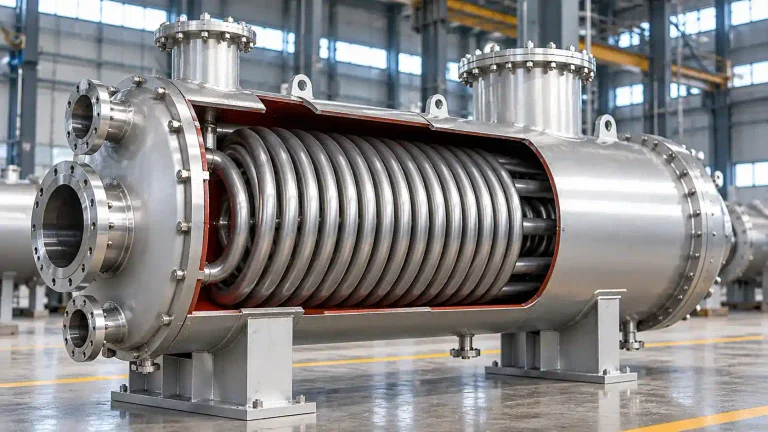
A shell & coil heat exchanger is a compact heat transfer device widely used in industrial heating, cooling, steam condensation, and energy recovery systems.
Its helical tube arrangement provides a relatively large heat-transfer surface within a compact shell, making it an attractive option where installation space is limited.
However, not all shell and coil heat exchangers deliver the same performance or service life.
The choice of tube material, coil geometry, fluid properties, operating pressure, and corrosion resistance can significantly influence long-term reliability.
For applications involving aggressive chemicals or corrosive process fluids, selecting the right construction material becomes especially important.
This article explains how shell and coil heat exchangers operate, compares conventional materials and designs, and examines how fluoropolymer-steel composite technology may offer an alternative for selected corrosion-sensitive applications.
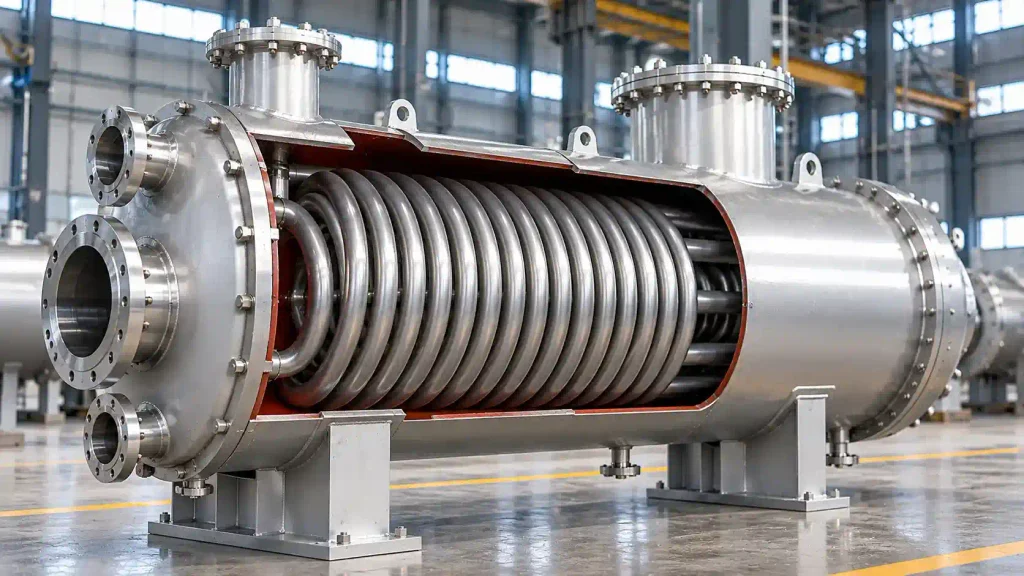
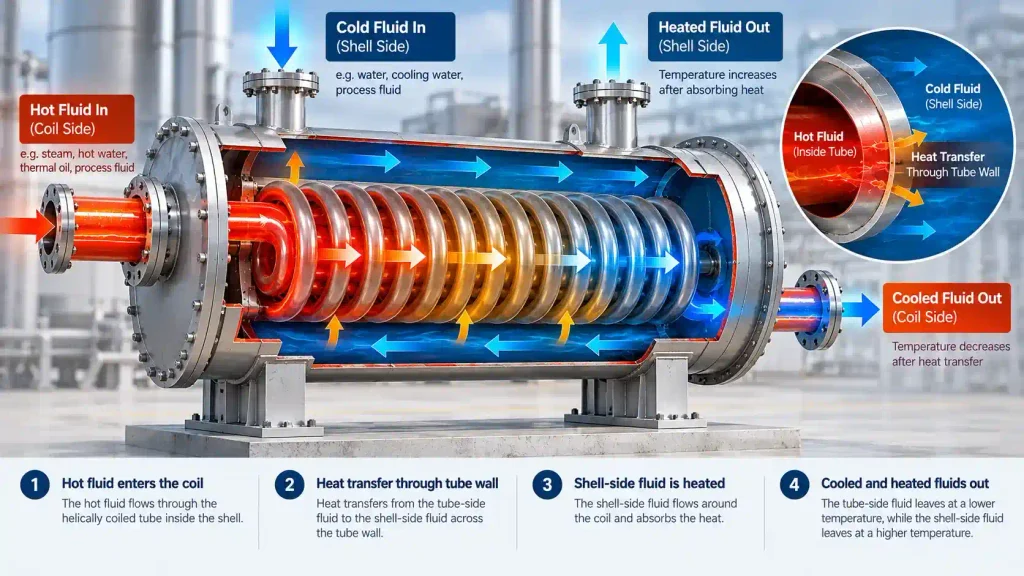
A shell & coil heat exchanger consists of one or more helically wound tubes enclosed within an outer shell.
One fluid flows through the coiled tubing, while another fluid circulates through the surrounding shell space.
Heat transfers across the tube wall without direct mixing between the two fluids.
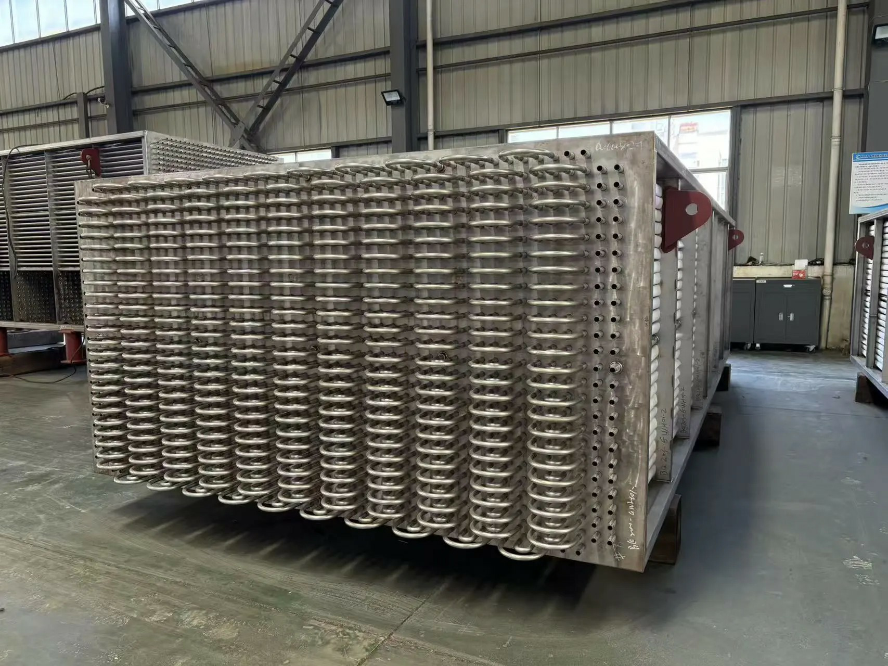
The helical configuration provides a longer flow path within a relatively compact vessel.
Depending on the design, the curved tube geometry can also promote secondary flow patterns that improve convective heat transfer.
A typical shell and coil heat exchanger includes:
Some designs feature removable coil assemblies to facilitate inspection and maintenance.
Others use permanently welded construction to reduce potential leakage points.
The appropriate configuration depends on process requirements and maintenance accessibility.
One important advantage of a helical coil heat exchanger is its ability to provide substantial tube length within a compact installation.
Compared with straight tubing, a curved flow path can generate secondary circulation within the fluid.
This may enhance mixing and reduce the thermal boundary layer near the tube wall.
As a result, the tube-side heat-transfer coefficient can be higher than that of a comparable straight tube under certain operating conditions.
However, enhanced heat transfer does not automatically mean higher overall efficiency.
The total performance depends on several factors.
The number of coil turns, tube diameter, and coil length determine the available surface area.
Higher fluid velocity can improve convective heat transfer but also increases frictional pressure loss.
The temperature difference between the two fluids determines the driving force for heat transfer.
Tube-wall thickness and material thermal conductivity influence the resistance between the two fluids.
Deposits on either side of the tube can reduce heat-transfer performance over time.
A properly engineered shell and coil exchanger must balance all these factors rather than maximize a single performance parameter.
Material selection is one of the most important decisions in heat exchanger manufacturing.
Different materials offer different combinations of thermal conductivity, corrosion resistance, strength, cost, and manufacturability.
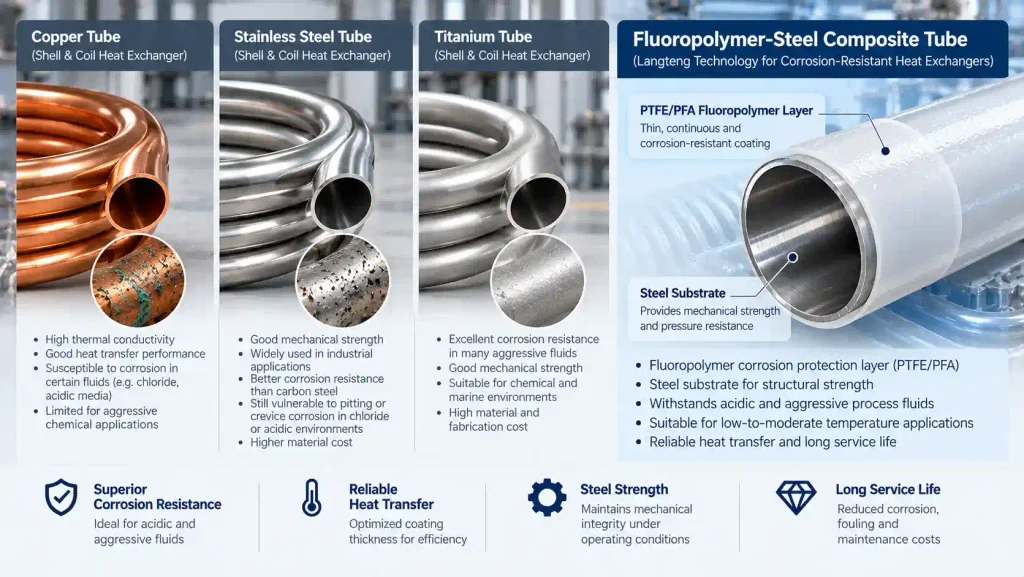
Copper is frequently used in compact heating applications because of its excellent thermal conductivity.
Advantages:
Limitations:
Copper remains a practical choice where operating conditions are compatible with the material.
Stainless steel is widely used in industrial shell and coil equipment.
Common grades include 304 and 316L, depending on process requirements.
Advantages:
Limitations:
Lower thermal conductivity than copper
Possible pitting or crevice corrosion in chloride-containing environments
Corrosion resistance depends on alloy grade and chemical conditions
Higher material cost than conventional carbon steel
Stainless steel is often an effective general-purpose solution, but it is not universally corrosion-proof.
Titanium and selected high-alloy materials may be used where more demanding corrosion resistance is required.
These materials can perform well in specific chemical environments.
However, higher material costs and specialized manufacturing requirements can affect project economics.
The appropriate material should be selected through chemical compatibility assessment and lifecycle evaluation.
Corrosion becomes a critical consideration when shell and coil heat exchangers handle aggressive process fluids.
Potentially challenging environments include acidic solutions, chloride-containing water, certain chemical process streams, and corrosive condensates.
The actual corrosion mechanism depends on fluid chemistry, temperature, concentration, dissolved oxygen, and other operating conditions.
Corrosion can create several operational problems.
Loss of Mechanical Integrity
Localized attack may reduce wall thickness and eventually cause leakage.
Process Contamination
Corrosion products may enter the circulating fluid and affect downstream equipment or product quality.
Reduced Thermal Performance
Corrosion products and associated deposits may increase thermal resistance.
Maintenance and Replacement Costs
Unexpected equipment failures can require shutdowns, repairs, and replacement components.
For industrial facilities, the economic consequences of exchanger failure may extend well beyond the initial equipment price.
This is why material compatibility should be evaluated alongside heat-transfer performance.
Langteng specializes in fluoropolymer-steel composite heat-transfer technology for corrosive industrial environments.
The technology combines a steel supporting structure with a thin fluoropolymer corrosion-protection layer.
Materials such as PTFE and PFA provide chemical resistance in many aggressive environments, while the steel substrate supplies structural support.
This approach is particularly relevant to Langteng's corrosion-resistant industrial heat recovery equipment.
The concept relies on separating two engineering functions.
Steel Provides Structural Strength
The metallic substrate supports mechanical loads and helps maintain equipment integrity.
Fluoropolymer Provides Corrosion Protection
The protective layer separates the underlying steel from compatible corrosive process media.
This combination may be valuable where conventional metallic heat-transfer surfaces experience corrosion-related limitations.
Potentially, but the feasibility depends on the coil geometry and manufacturing process.
A composite tube suitable for a straight-tube exchanger cannot automatically be assumed suitable for tight helical bending.
Coil manufacturing introduces additional requirements involving:
A composite shell and coil exchanger would therefore require a dedicated mechanical design and manufacturing qualification.
Langteng's established fluoropolymer-steel heat recovery technology provides a relevant material concept, but any proposed coil configuration must be evaluated against the actual process requirements.
The following comparison highlights the main material trade-offs.
| Material | Thermal Conductivity | Corrosion Resistance | Mechanical Strength | Main Consideration |
| Copper | Very high | Environment-dependent | Moderate | Excellent for compatible clean fluids |
| Stainless Steel | Moderate | Alloy-dependent | High | Versatile industrial applications |
| Titanium | Moderate | Excellent in selected environments | High | Higher material and fabrication costs |
| Full Fluoropolymer | Low | Strong in many aggressive chemicals | Limited relative to steel | Temperature, pressure and structural constraints |
| Fluoropolymer-Steel Composite | Depends on layer and substrate design | Strong when chemically compatible and coating remains intact | Steel-supported | Protective-layer integrity and added thermal resistance |
It is important to recognize that a fluoropolymer layer introduces additional thermal resistance.
Therefore, a composite tube does not necessarily provide a higher heat-transfer coefficient than an unprotected metallic tube.
Its potential advantage lies in achieving acceptable thermal performance while reducing corrosion exposure under suitable conditions.
This distinction is essential when comparing engineering solutions.
Buyers often compare shell and coil equipment with conventional straight-tube shell and tube exchangers.
Both technologies are capable of reliable industrial heat transfer.
The main differences relate to geometry, maintenance, operating conditions, and equipment size.
A helical coil arrangement can offer:
Conventional shell and tube equipment may provide:
Neither configuration is universally superior.
For clean fluids and compact heating systems, shell and coil equipment may be particularly attractive.
For large industrial duties, heavy fouling, or applications requiring extensive mechanical cleaning, conventional shell and tube equipment may be more appropriate.
The decision should be based on process conditions and total operating cost.
Shell and coil exchangers are used to transfer heat between steam, hot water, and process fluids.
Their compact arrangement is useful where installation space is limited.
Chemical plants may require heat exchangers for heating or cooling process solutions.
Corrosion-resistant materials become important when fluid compatibility limits conventional metal construction.
Shell and coil equipment is commonly applied in domestic hot water production and district heating interfaces.
Stainless steel and copper designs are often suitable for these applications.
Waste heat from compatible process streams may be transferred to water or other useful heating media.
However, conventional shell and coil equipment should not be confused with a flue gas economizer.
For large-volume, particulate-laden, or corrosive industrial flue gas, specialized gas-side heat exchanger arrangements may be more suitable than compact liquid-service coil exchangers.
Certain industrial recovery processes involve acidic or chemically aggressive condensates.
In these applications, corrosion-resistant construction and careful material selection may be necessary.
As a heat exchanger manufacturer, Langteng recommends evaluating the complete operating duty before choosing a particular exchanger geometry or material.
The most important information includes:
Process Media
Identify both fluids, their composition, and any corrosive or fouling characteristics.
Operating Temperatures
Provide inlet and target outlet temperatures for both fluid streams.
Flow Rates
Accurate flow information is essential for thermal sizing and pressure-drop calculations.
Design Pressure
Confirm normal operating pressure, design pressure, and any pressure cycling requirements.
Material Compatibility
Evaluate corrosion potential at the expected temperatures and chemical concentrations.
Maintenance Access
Consider whether the coil must be removable and how the equipment will be cleaned.
Installation Requirements
Review available space, equipment orientation, connection standards, and support requirements.
For composite materials, additional qualification may be necessary to establish manufacturing feasibility and protective-layer durability.
The lowest initial equipment cost does not always produce the lowest total operating cost.
A complete evaluation should consider:
For compatible, non-corrosive applications, conventional copper or stainless steel shell and coil exchangers may offer excellent economic value.
For highly corrosive services, alternative alloys, polymer materials, or composite constructions may deserve further investigation.
The most economical solution is the one that meets the required duty reliably throughout its intended operating life.
Langteng is a China-based manufacturer specializing in fluoropolymer-steel composite heat recovery equipment for challenging industrial environments.
Our core expertise includes corrosion-resistant flue gas economizers, condensers, air preheaters, and customized thermal recovery systems.
Rather than applying one exchanger configuration to every application, our engineering approach begins with the process conditions.
We consider thermal duty, fluid chemistry, material compatibility, structural requirements, and long-term operating reliability.
For applications where conventional shell and coil heat exchangers experience corrosion-related limitations, these principles can help determine whether an alternative material or heat exchanger configuration is more appropriate.
The objective is to select a practical engineering solution, not simply replace conventional materials without evaluating the consequences.
Shell & coil heat exchangers offer an effective combination of compact design, flexible installation, and useful heat-transfer performance.
Conventional copper and stainless steel models remain excellent choices for many heating, cooling, and industrial utility applications.
However, aggressive process conditions may require a more detailed assessment of corrosion resistance and lifecycle performance.
Fluoropolymer-steel composite technology represents a different approach to protecting heat-transfer surfaces in corrosive environments, although its suitability for helical coil construction requires application-specific validation.
Looking for a corrosion-resistant industrial heat recovery solution?
Contact Langteng to discuss your operating temperatures, process media, corrosion challenges, and heat recovery requirements.
Our engineering team can help evaluate suitable material systems and equipment configurations for your project.

@ 2025-2026 Langteng Machinery. All Rights Reserved.