Time: Oct 29 2026 Views: 11
For many industrial facilities, energy efficiency is no longer simply an environmental objective. It is a financial decision.
Boilers, furnaces, kilns, and industrial heating systems often discharge flue gas containing recoverable thermal energy. Even when a plant already operates a conventional economizer or air preheater, additional heat may remain available in the downstream exhaust.
Low-temperature flue gas waste heat recovery offers an opportunity to convert part of that remaining energy into lower fuel consumption and reduced operating expenses.
However, the financial value of a heat recovery project depends on more than the temperature of the exhaust gas. Engineers and plant managers must consider annual operating hours, available heat demand, corrosion conditions, installation costs, and equipment reliability.
This article examines the economics of low-temperature flue gas heat recovery, explains how to calculate return on investment, and identifies industrial equipment and sectors where retrofitting corrosion-resistant heat exchangers may be commercially attractive.
Industrial combustion systems convert fuel into useful heat, but not all the supplied energy reaches the intended process.
A portion leaves the system through exhaust gas.
The U.S. Department of Energy identifies waste heat as a significant source of industrial energy loss and recognizes heat recovery as an opportunity to reduce operating costs.
Many facilities already recover some exhaust heat through conventional equipment. Yet these systems may be designed to keep exhaust temperatures above a corrosion-related limit.
As a result, recoverable heat may remain in the flue gas.
Low-temperature heat recovery targets this remaining thermal energy.
The potential economic benefits include:
The central economic question is straightforward:
Can the value of recovered heat exceed the installed and ongoing costs of the recovery system?
A technically successful installation is not automatically an economically attractive investment. The recovered heat must also have a reliable, useful destination.
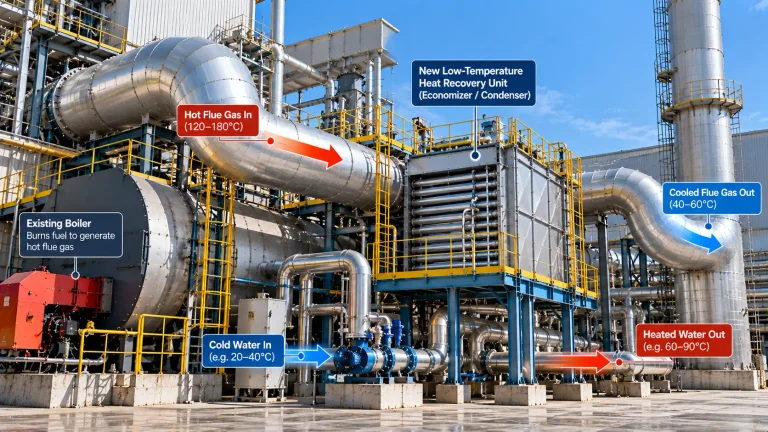
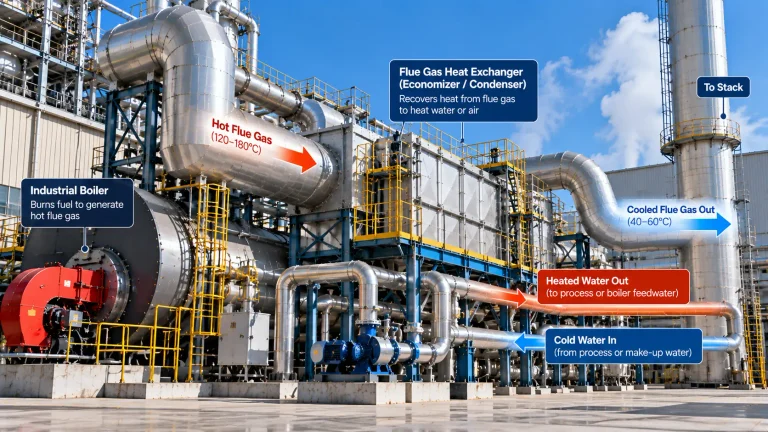
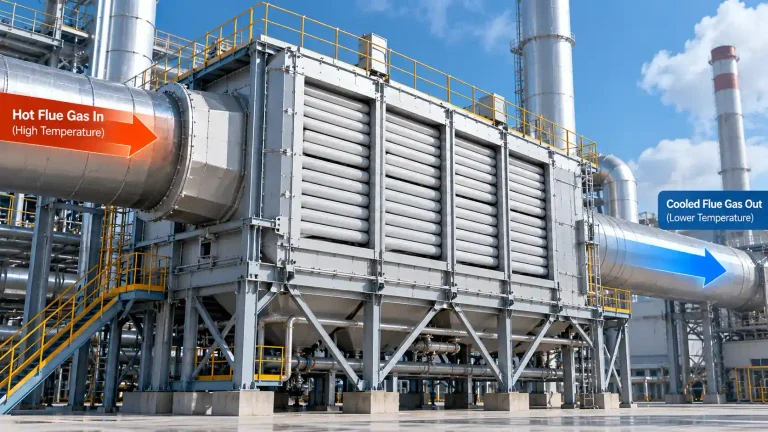
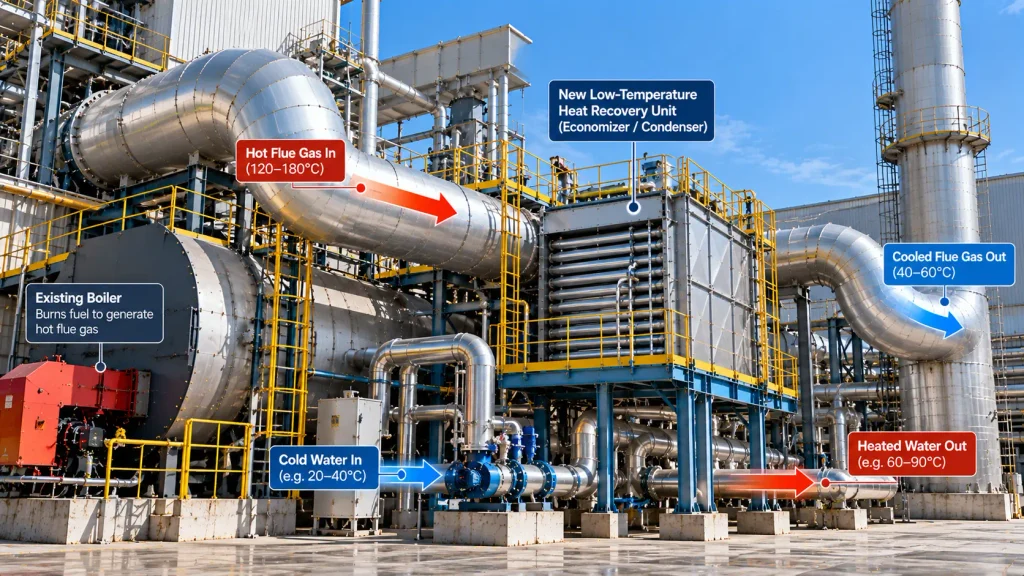
A low-temperature heat recovery system typically transfers thermal energy from exhaust gas to water, air, or another process medium.
Consider an industrial boiler.
Without additional recovery, the boiler discharges exhaust gas containing unused heat.
After installing a suitable heat exchanger, some of that heat can be transferred to incoming process water.
The preheated water then requires less additional energy to reach its target temperature.
This creates a direct opportunity to reduce fuel consumption.
Sensible heat recovery lowers the temperature of the flue gas without necessarily causing water vapor condensation.
For example, an economizer may transfer heat from boiler exhaust to feedwater or another water circuit.
The amount of heat recovered depends on exhaust flow, temperature reduction, and thermal properties.
A condensing heat exchanger can recover additional energy when exhaust gas is cooled sufficiently for water vapor to condense.
Condensation releases latent heat, which can be transferred to a suitable heat sink.
This may increase the amount of useful energy recovered.
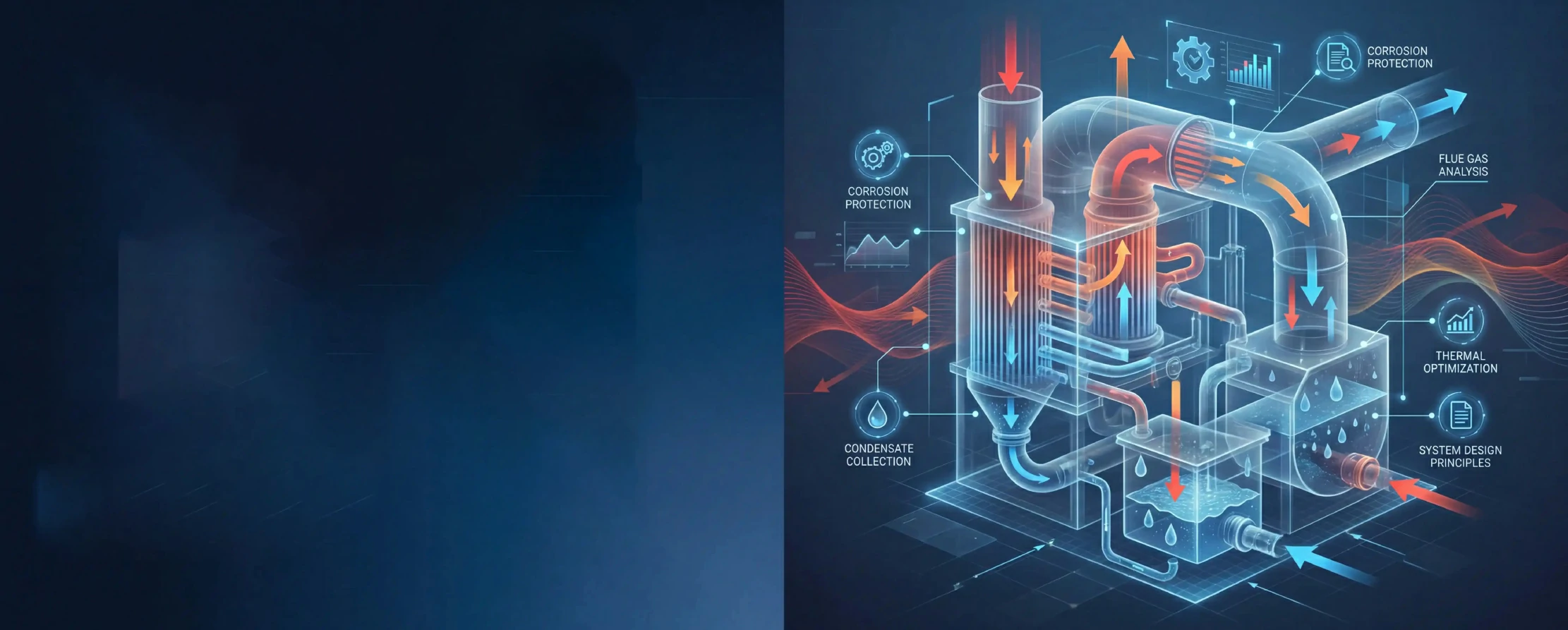
However, condensation also creates new engineering requirements, including condensate collection, material compatibility, and downstream corrosion protection.
For sulfur-containing or chemically aggressive exhaust, acidic condensation may become a critical design consideration.
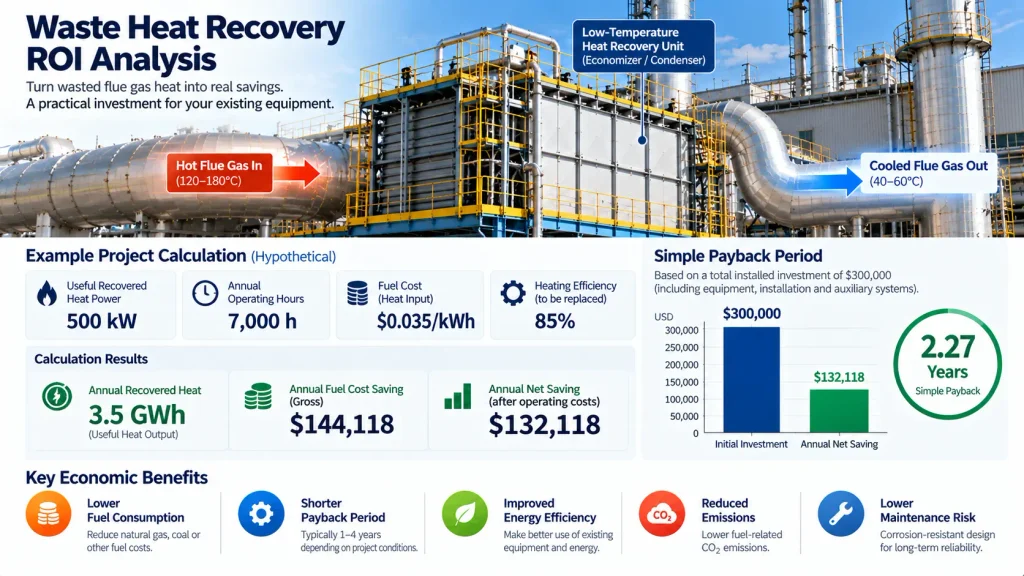
An investment assessment should distinguish between recovered thermal energy, avoided fuel costs, and net financial savings.
For a preliminary gas-side calculation:
Recovered Heat (kW) ≈ Flue Gas Mass Flow (kg/s) × Specific Heat (kJ/kg·K) × Temperature Reduction (K)
This is a simplified sensible-heat calculation.
If condensation occurs, the additional latent heat and changing gas composition must also be considered.
For financial analysis, the most useful value is the heat that can actually be transferred to and used by the receiving process.
Annual Recovered Heat (kWh) = Useful Recovered Heat (kW) × Annual Operating Hours (h)
A facility operating continuously may achieve greater annual savings than a similar installation operating only intermittently.
This makes annual utilization one of the most important economic variables.
If the recovered heat replaces energy supplied by an existing boiler or heater:
Avoided Fuel Input (kWh) = Annual Useful Recovered Heat ÷ Existing Heating Efficiency
The value of this avoided fuel can then be calculated using the plant's actual fuel cost.
A heat recovery system may require:
These costs must be deducted from gross energy savings.
Simple Payback (Years) = Total Installed Investment ÷ Annual Net Savings
Simple payback is useful for initial screening.
For larger projects, a more complete assessment should also include equipment life, discount rate, fuel-price scenarios, replacement costs, and net present value.
Consider a hypothetical industrial facility operating a boiler with recoverable exhaust heat.
The plant is evaluating an additional low-temperature heat exchanger to supply hot water for an existing process.
| Parameter | Assumed Value |
| Useful recovered thermal power | 500 kW |
| Annual operating hours | 7,000 hours |
| Annual useful recovered heat | 3,500,000 kWh |
| Avoided fuel price | $0.035/kWh of fuel input |
| Existing heating efficiency | 85% |
| Additional annual operating costs | $12,000 |
| Total installed project investment | $300,000 |
All values are hypothetical and provided for calculation purposes. They do not represent a Langteng project or a current market quotation.
Annual avoided fuel input:
3,500,000 ÷ 0.85 = approximately 4,117,647 kWh
Gross annual fuel savings:
4,117,647 × $0.035 = approximately $144,118
After deducting $12,000 in additional annual operating costs:
Annual net savings = approximately $132,118
$300,000 ÷ $132,118 = approximately 2.27 years
Under these assumptions, the investment could recover its initial installed cost in approximately 2.3 years.
This result is sensitive to actual heat demand, fuel prices, project cost, equipment performance, and operating hours.
If the plant cannot use all the recovered heat, annual savings would be lower.
Likewise, if the retrofit requires extensive ductwork, a new induced-draft fan, or major shutdown work, the initial investment may be substantially higher.
The economic value of waste heat recovery comes from usable energy, not simply the existence of hot exhaust.
A project with a smaller recoverable heat load but continuous demand may be more attractive than a larger installation with intermittent operation.
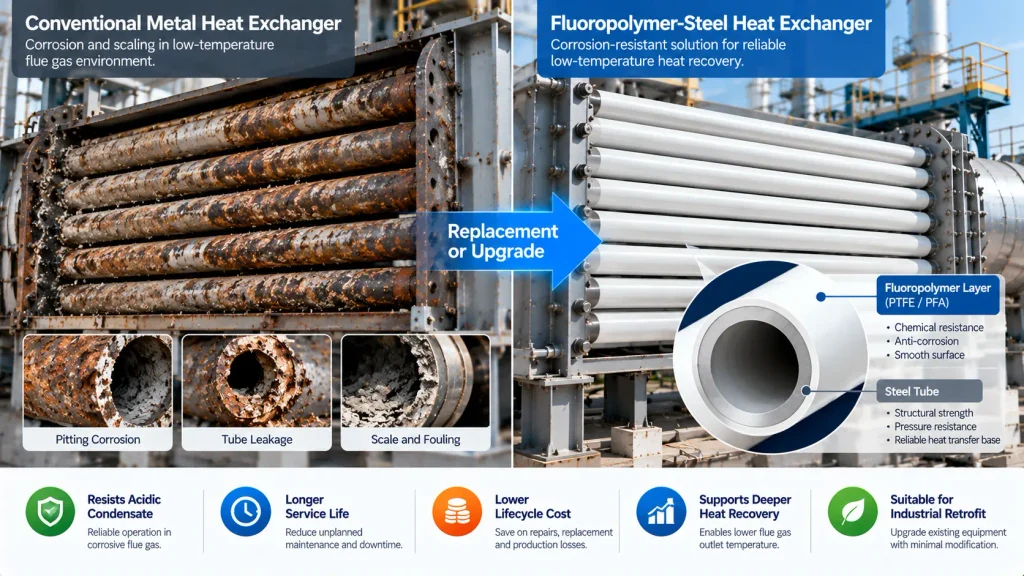
Low-temperature flue gas recovery is particularly relevant to industrial facilities with established combustion systems.
In most cases, the objective is not to replace the primary production equipment.
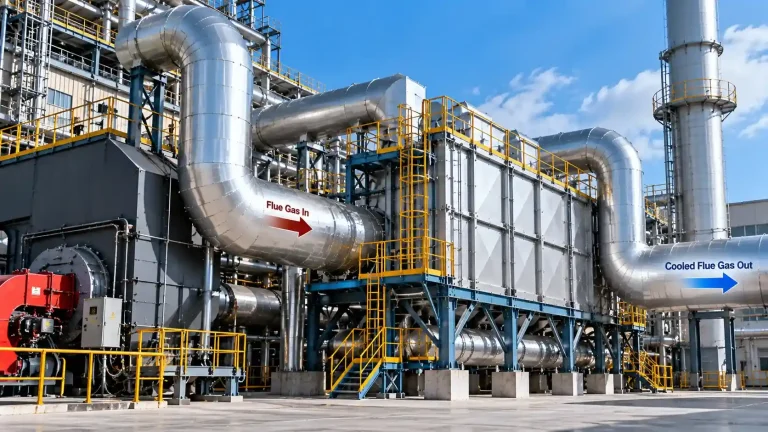
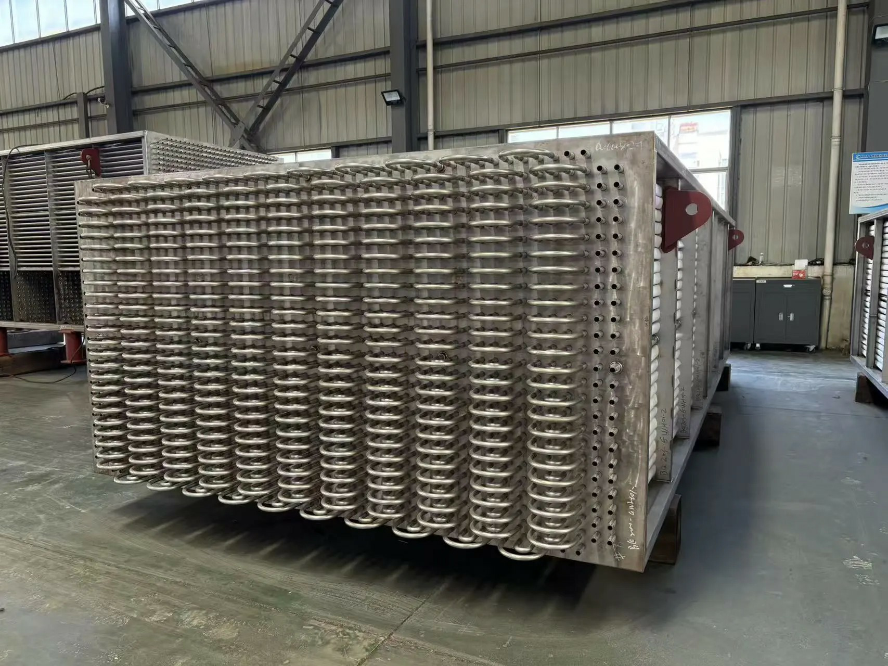
Instead, engineers install an additional heat recovery section or upgrade an existing exhaust-side heat exchanger.
Retrofit opportunities:
Industrial boilers are attractive candidates because they often operate for long periods and have established requirements for feedwater or process-water heating.
A retrofit may involve installing a secondary economizer or condensing heat exchanger downstream of existing recovery equipment.
Where the existing economizer suffers from low-temperature corrosion, replacing the affected heat transfer section with a suitable corrosion-resistant design may also be considered.
Retrofit opportunities:
Industrial furnaces may discharge substantial quantities of hot exhaust gas.
After primary heat recovery, additional energy may remain available.
The economic feasibility depends on the exhaust conditions and whether the facility has a compatible lower-temperature heating requirement.
Retrofit opportunities:
Air preheaters are exposed to temperature differences and, in some applications, acidic condensation.
Where corrosion occurs, a materials upgrade may reduce maintenance exposure.
However, any replacement must preserve the required air and gas flow rates, pressure drop, and thermal performance.
Retrofit opportunities:
Facilities using flue gas coolers may already have a heat transfer arrangement suitable for modification.
An engineering assessment can determine whether replacing the existing heat exchanger or adding a separate recovery stage offers better lifecycle economics.
Retrofit opportunities:
When existing equipment experiences repeated corrosion or leakage, the business case for replacement may include both energy savings and avoided maintenance costs.
The replacement decision should consider the remaining life of the current equipment and the compatibility of alternative materials.
Not every industry offers the same technical or commercial potential.
The most promising projects usually combine continuous exhaust heat, a useful heat sink, and a clear operating-cost problem.
Chemical plants may operate boilers, furnaces, process heaters, and thermal treatment equipment.
Depending on the process, exhaust gas may contain corrosive compounds.
Potential applications:
Chemical processing is particularly relevant when both energy losses and corrosive gas conditions must be addressed.
Thermal power plants and industrial power-generation facilities often incorporate multiple heat recovery stages.
Potential applications:
Large exhaust flow rates can create significant thermal recovery potential.
However, these projects may require extensive engineering because of plant integration, emissions controls, and operating constraints.
Steel and metallurgical facilities operate energy-intensive thermal processes.
Potential heat sources include boilers, furnaces, and other combustion-related equipment.
Potential applications:
Dust loading and fouling can be major concerns.
For this reason, suitability must be evaluated based on the specific exhaust stream rather than industry classification alone.
Some chemical and metallurgical processes produce exhaust streams containing sulfur compounds.
These conditions may create acid dew-point corrosion risks during cooling.
Potential applications:
Material compatibility must be verified against the actual chemical composition, temperature, and condensate concentration.
Fluoropolymer-steel construction is not automatically suitable for every acid concentration or process condition.
Waste treatment facilities may produce exhaust gas containing moisture, acid-forming compounds, and particulate matter.
Potential applications:
These applications require particular attention to fouling, condensate chemistry, emissions controls, and corrosion of downstream equipment.
These industries frequently use steam, hot water, and industrial boilers.
Their financial advantage is often the availability of consistent low-temperature heat demand.
Potential applications:
For relatively clean exhaust, conventional metallic heat exchangers may be economically preferable.
Fluoropolymer-steel technology becomes more relevant when the operating environment creates a justified corrosion-protection requirement.
Industrial facilities generally have three investment options.
| Investment Option | Typical Situation | Economic Consideration |
| Add a secondary heat recovery unit | Existing equipment works but exhaust heat remains unused | Additional energy savings versus installation cost |
| Replace an aging or corroded exchanger | Existing heat recovery equipment requires frequent repairs | Energy savings plus avoided maintenance and downtime |
| Upgrade the complete heat recovery arrangement | Existing design has thermal, corrosion, or operating limitations | Higher capital cost but potentially broader lifecycle benefits |
This approach can be attractive when the existing primary economizer or air preheater remains in good condition.
The additional unit captures heat that would otherwise leave the system.
The investment must be justified by incremental savings, not total boiler efficiency.
Where the existing heat exchanger repeatedly fails, the economic assessment should include the cost of continued operation.
Potential costs include:
A more corrosion-resistant design may provide economic value even if its initial purchase price is higher.
A larger upgrade may be appropriate when existing ducting, controls, heat recovery surfaces, or downstream equipment are unsuitable for deeper cooling.
This option requires a full lifecycle assessment because installation complexity can dominate the investment.
For corrosive low-temperature flue gas, material selection can influence the financial viability of heat recovery.
Conventional metals often provide high thermal conductivity and may be the most economical choice under non-corrosive conditions.
However, aggressive condensate can shorten the service life of unsuitable materials.
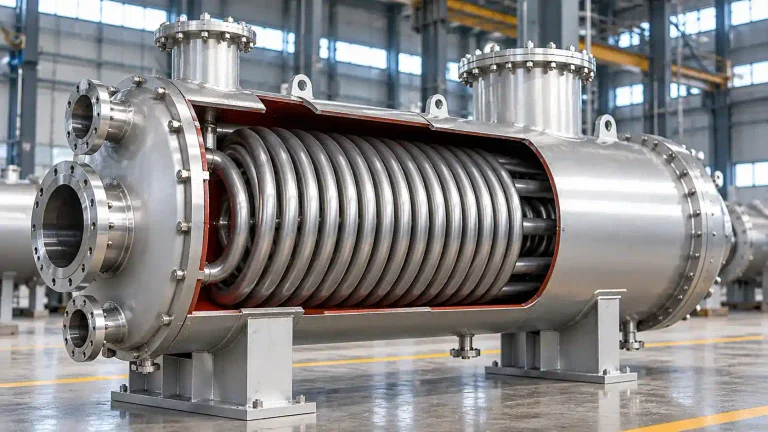
Langteng Thermal develops fluoropolymer-steel composite heat exchanger solutions for selected corrosive industrial environments.
The technology combines a fluoropolymer protective layer with a steel substrate.
Reduced corrosion exposure
An appropriately selected protective layer can help isolate steel from aggressive condensate.
Lower risk of premature replacement
Where corrosion is a primary failure mechanism, improved material compatibility may reduce the likelihood of early equipment failure.
Support for deeper heat recovery
Suitable corrosion-resistant construction may allow additional exhaust cooling where conventional materials would face unacceptable corrosion risk.
Lifecycle cost optimization
The financial comparison should include acquisition cost, energy savings, inspection, cleaning, maintenance, downtime, and expected service life.
These benefits are application-dependent and should be verified through engineering evaluation.
Fluoropolymers have lower thermal conductivity than conventional heat exchanger metals.
The protective layer therefore introduces additional thermal resistance.
Heat exchanger design must balance corrosion protection with required heat transfer performance.
The objective is not to claim that fluoropolymer-steel always transfers heat more efficiently than metal.
It is to determine whether its corrosion resistance enables a more economical and reliable recovery system under the actual operating conditions.
Longer annual operation generally increases the amount of recoverable energy.
Continuous-process industries may offer stronger utilization than facilities operating only occasionally.
Recovered heat has limited economic value without a suitable destination.
A continuous requirement for hot water, feedwater heating, or process heating can improve project economics.
Higher avoided energy costs generally increase the financial value of recovered heat.
Project calculations should use actual contracted or expected energy prices rather than generic market averages.
Facilities with recurring exchanger corrosion may have a stronger replacement case.
The financial value of avoided downtime can be important, but it should be based on documented plant maintenance and production records.
Equipment purchase price is only one part of the investment.
Other costs may include:
A reliable payback calculation must include these costs.
Waste heat recovery is not suitable for every industrial facility.
Projects may offer weak returns when:
In some cases, improving combustion controls, repairing insulation, or maintaining existing heat exchangers may offer a better initial return.
A responsible engineering assessment should compare these alternatives before recommending new equipment.
Before selecting equipment, plant engineers should collect the following information.
| Required Information | Purpose |
| Existing boiler or furnace type | Identify system configuration |
| Fuel type | Assess combustion products |
| Flue gas flow rate | Estimate available thermal energy |
| Flue gas inlet temperature | Determine recovery potential |
| Current outlet temperature | Establish baseline performance |
| Gas composition | Assess corrosion risks |
| Dust and particulate loading | Evaluate fouling |
| Available water or air heat sink | Determine useful heat demand |
| Annual operating hours | Estimate annual savings |
| Current fuel cost | Calculate avoided energy expense |
| Existing equipment condition | Assess retrofit or replacement need |
| Allowable gas-side pressure drop | Evaluate fan and system constraints |
| Installation space | Assess retrofit feasibility |
These parameters allow engineers to prepare a preliminary heat balance and evaluate suitable equipment options.
Low-temperature flue gas heat recovery can transform unused thermal energy into measurable operating-cost savings.
Its financial value depends on how much heat can be recovered, how consistently that heat can be used, and how much the complete system costs to install and operate.
For existing industrial facilities, the strongest opportunities often involve upgrading conventional economizers, replacing corrosion-damaged heat exchangers, or adding a secondary recovery stage downstream of existing equipment.
Chemical processing, power generation, metallurgy, environmental treatment, and steam-intensive manufacturing can all offer potential applications.
Where corrosive condensation limits conventional heat recovery, fluoropolymer-steel composite technology provides an additional material option.
The most attractive investment is not necessarily the system with the lowest exhaust temperature or highest theoretical heat recovery.
It is the system that delivers the greatest reliable economic benefit over its operating life.
Langteng Thermal provides corrosion-resistant flue gas heat exchanger solutions for demanding industrial applications.
Share your flue gas temperature, flow rate, chemical composition, existing equipment arrangement, and available heat demand with our engineering team.
We can help evaluate suitable heat exchanger configurations for your low-temperature waste heat recovery project.

@ 2025-2026 Langteng Machinery. All Rights Reserved.