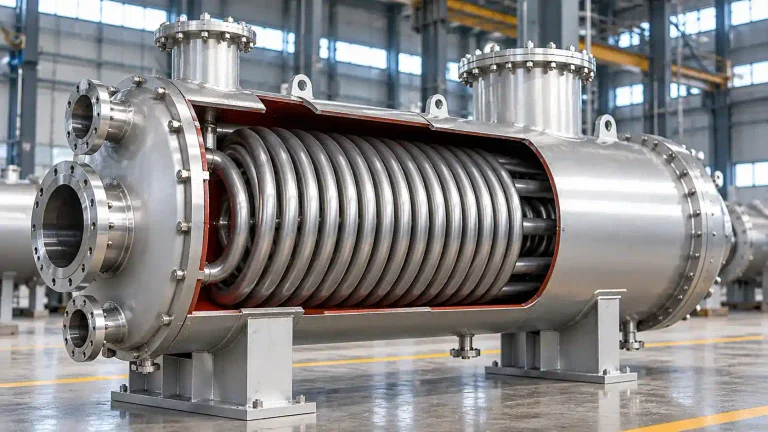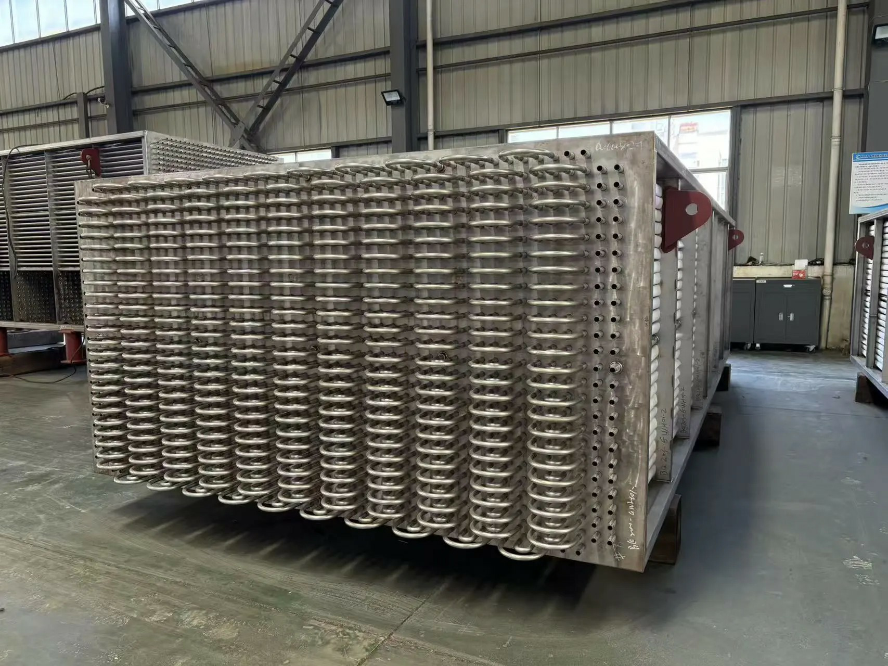

Time: Oct 27 2026 Views: 15
Industrial boilers, furnaces, and process heating equipment generate large volumes of hot flue gas during operation. Much of this thermal energy is discharged through exhaust stacks, even though it could potentially be reused elsewhere in the facility.
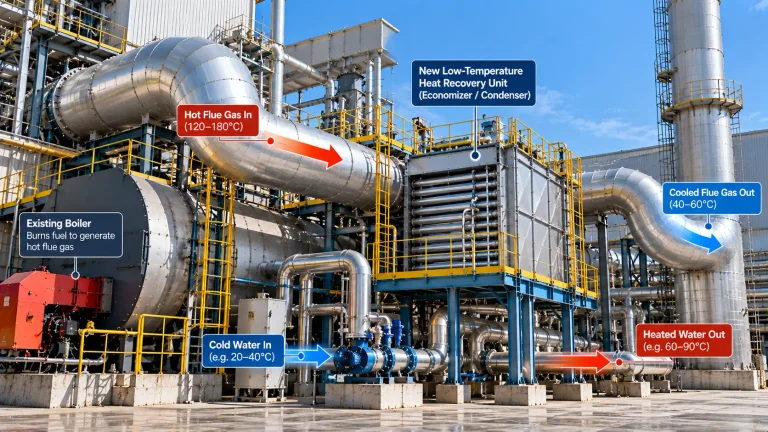
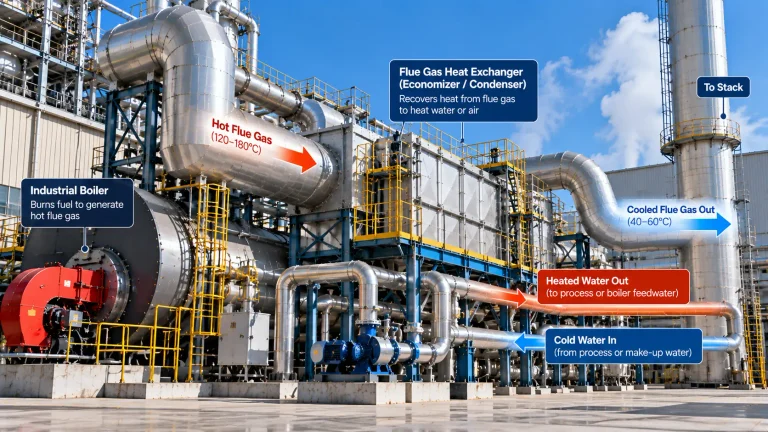
Flue gas heat recovery systems capture part of this otherwise wasted energy and transfer it to useful heating applications, such as boiler feedwater preheating, combustion air heating, and industrial process water heating.
However, recovering heat from flue gas is not simply a matter of installing a heat exchanger. As exhaust temperatures decrease, condensation, corrosion, fouling, and pressure drop can become critical engineering challenges.
This article explains what flue gas heat recovery systems are, how they work, their main benefits, and how fluoropolymer-steel composite technology can support heat recovery in corrosive industrial environments.
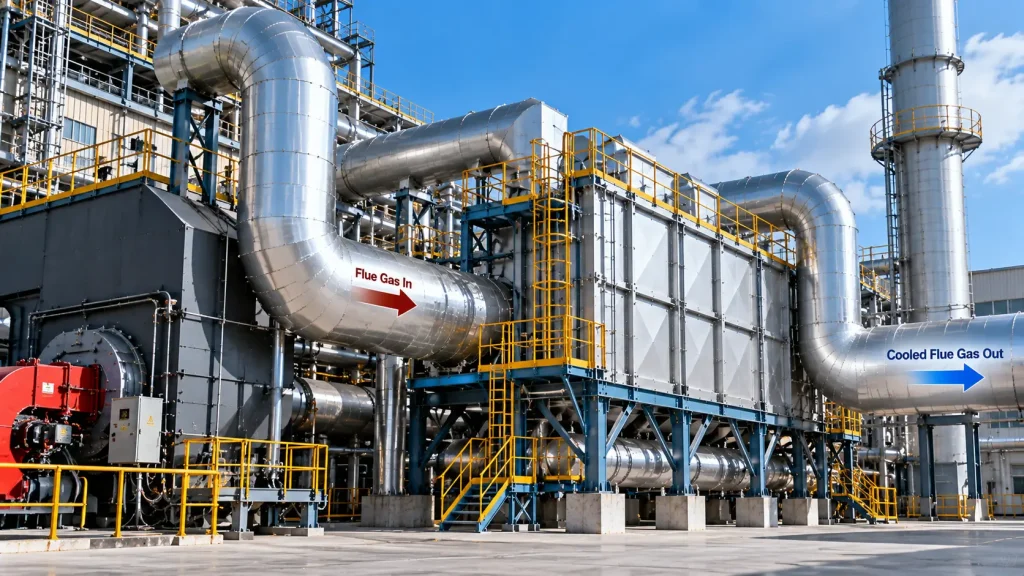
A flue gas heat recovery system is an industrial energy-saving system designed to extract thermal energy from exhaust gases before they are released into the atmosphere.
Flue gas is produced by combustion processes in equipment such as:
These exhaust gases often retain substantial thermal energy after the primary heating process is complete.
A heat recovery system transfers some of that energy to another medium, usually water or air, reducing the amount of additional fuel required to achieve the desired heating temperature.
A typical system may include:
| Component | Main Function |
| Flue Gas Heat Exchanger | Transfers heat from exhaust gas to a useful medium |
| Gas Ducting | Directs flue gas through the recovery equipment |
| Water or Air Circuit | Receives and transports recovered thermal energy |
| Pumps and Valves | Regulate heat transfer medium flow |
| Temperature and Pressure Sensors | Monitor operating conditions |
| Condensate Drainage | Removes condensate where condensation occurs |
| Control System | Maintains stable and safe operation |
The exact configuration depends on the flue gas composition, temperature, flow rate, available heat sink, and intended application.
For example, a boiler installation may use a flue gas economizer to preheat feedwater, while a lower-temperature application may require a corrosion-resistant condenser to recover additional heat.
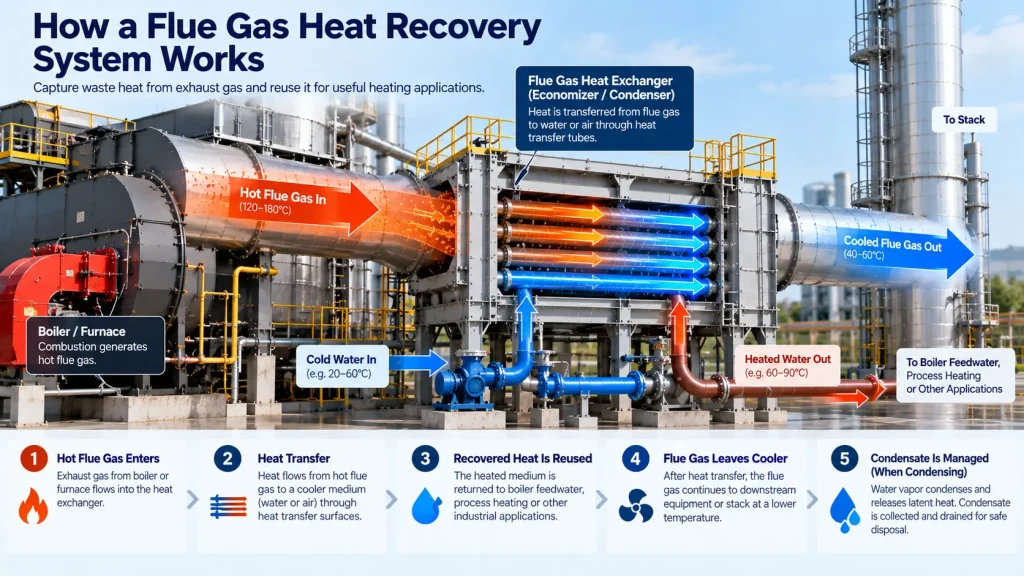
The basic operating principle is straightforward: heat flows from the hotter flue gas to a cooler fluid through a heat transfer surface.
In most indirect heat recovery systems, the flue gas and the receiving fluid remain physically separated.
The process generally involves five steps.
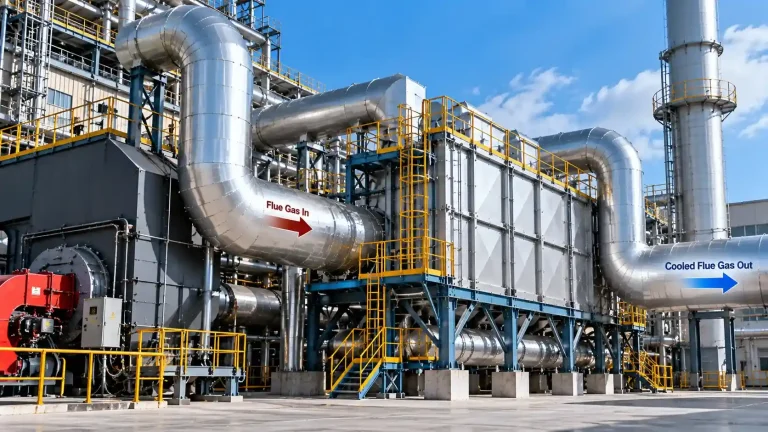
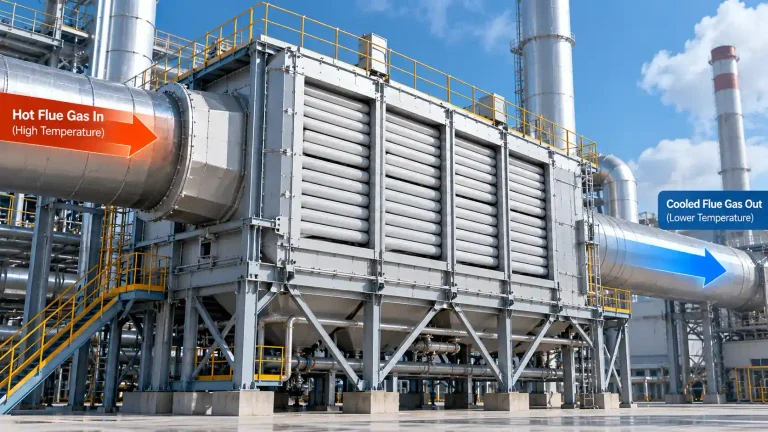
Hot exhaust gas leaves the boiler, furnace, or industrial process and enters a heat exchanger installed along the exhaust gas path.
The available heat recovery potential depends on the gas temperature, mass flow rate, composition, and operating schedule.
A continuously operating industrial boiler, for example, may provide a more predictable heat source than a furnace operating in short production cycles.
Inside the heat exchanger, hot flue gas passes over heat transfer surfaces while a cooler medium flows through a separate circuit.
Depending on the equipment design, the receiving medium may be:
The temperature difference between the two streams drives heat transfer.
As the flue gas releases thermal energy, its temperature decreases while the receiving medium becomes warmer.
The heated medium is returned to a useful industrial process.
For example, preheated boiler feedwater requires less additional energy to reach its target temperature.
Similarly, preheating combustion air can reduce the fuel needed to maintain a specified furnace temperature.
The value of recovered heat depends not only on how much energy is captured but also on whether the facility has a suitable and consistent demand for that heat.
After transferring heat, the cooled flue gas continues through the downstream exhaust treatment equipment or stack.
Lower exhaust temperatures generally indicate that more thermal energy has been extracted.
However, reducing the gas temperature too far without appropriate materials and system design can create condensation and corrosion risks.
In condensing heat recovery systems, water vapor in the flue gas may condense on the heat transfer surfaces.
This process releases additional thermal energy known as latent heat.
Depending on the fuel and flue gas composition, the resulting condensate may contain acidic substances.
Condensing systems therefore require suitable corrosion-resistant materials, drainage arrangements, and condensate handling provisions.
Flue gas heat recovery technologies can be divided into two broad categories.
Non-condensing systems primarily recover sensible heat, which is the energy associated with a decrease in gas temperature without intentionally condensing significant quantities of water vapor.
Typical equipment includes:
These systems are commonly designed to maintain appropriate temperature margins against damaging condensation.
They are suitable for many industrial applications where sufficient heat can be recovered without entering a highly corrosive operating regime.
Condensing systems cool the flue gas sufficiently to recover additional energy through water vapor condensation.
This allows the system to capture:
Sensible heat: Energy recovered as the gas temperature decreases.
Latent heat: Energy released when water vapor condenses into liquid.
Condensing recovery can be especially attractive when a facility has a sufficiently cool return-water stream or another low-temperature heat sink.
However, water vapor condensation and acid condensation are not identical phenomena. Their onset temperatures depend on different components of the flue gas.
In sulfur-containing or chemically aggressive exhaust streams, acid condensation may begin at temperatures substantially above the water vapor dew point.
This distinction is essential when selecting heat exchanger materials.
Flue gas waste heat recovery can deliver several operational and economic benefits when properly matched to industrial process requirements.
The most direct benefit is lower fuel demand.
By transferring recovered heat to boiler feedwater, combustion air, or another process stream, the system reduces the additional energy needed from the primary heating equipment.
The actual savings depend on the amount of recoverable heat, operating hours, baseline efficiency, and how effectively the recovered energy is used.
Heat recovery increases the useful proportion of energy obtained from the fuel already consumed.
Instead of allowing all remaining exhaust heat to escape through the stack, the facility recovers part of it for productive use.
For industrial facilities with substantial and continuous thermal demand, this can be an important component of an energy efficiency improvement program.
Reduced fuel consumption can translate into lower energy expenditure.
However, the economic assessment should also consider:
A system that delivers high initial heat recovery but requires frequent shutdowns may be less attractive than a more reliable design with slightly lower peak performance.
When recovered heat replaces energy that would otherwise require additional fuel combustion, the facility can reduce associated carbon dioxide emissions.
The extent of the reduction depends on the fuel type, the amount of displaced fuel, and the complete operating conditions.
Flue gas heat recovery should not be confused with a dedicated emissions treatment system. It does not automatically remove all pollutants from the exhaust stream.
Waste heat recovery can improve energy utilization without necessarily increasing the capacity of the primary boiler or furnace.
It can also be incorporated into existing facilities as a retrofit, provided that space, ducting, structural support, pressure drop, and process integration requirements are addressed.
Recovering more heat usually requires lowering the exhaust gas temperature.
But as flue gas cools, the heat exchanger may encounter operating conditions that conventional materials cannot withstand reliably.
Industrial flue gas may contain sulfur compounds, chlorides, water vapor, and other chemically aggressive constituents.
Under suitable temperature and concentration conditions, acidic species can condense on heat transfer surfaces.
These condensates may attack exposed metal surfaces and contribute to:
The acid dew point is influenced by gas composition, moisture content, and operating conditions. It cannot be represented by one universal temperature for all industrial exhaust streams.
Flue gas may also carry dust, ash, or sticky deposits.
These materials can accumulate on heat transfer surfaces, reducing effective heat transfer and increasing gas-side resistance.
Condensation can make some deposits more difficult to remove.
Heat exchanger design must therefore consider gas velocity, tube arrangement, access for cleaning, and expected particulate loading.
Every heat recovery device introduces resistance to gas flow.
Excessive pressure drop can increase induced-draft fan demand or interfere with the operation of upstream equipment.
A successful design must balance heat transfer performance against acceptable gas-side pressure losses.
Conventional carbon steel, stainless steel, and corrosion-resistant alloys all have different performance limits.
Their suitability depends on the specific flue gas chemistry, temperature, condensation conditions, and expected service life.
In aggressive low-temperature applications, corrosion resistance can become just as important as thermal performance.
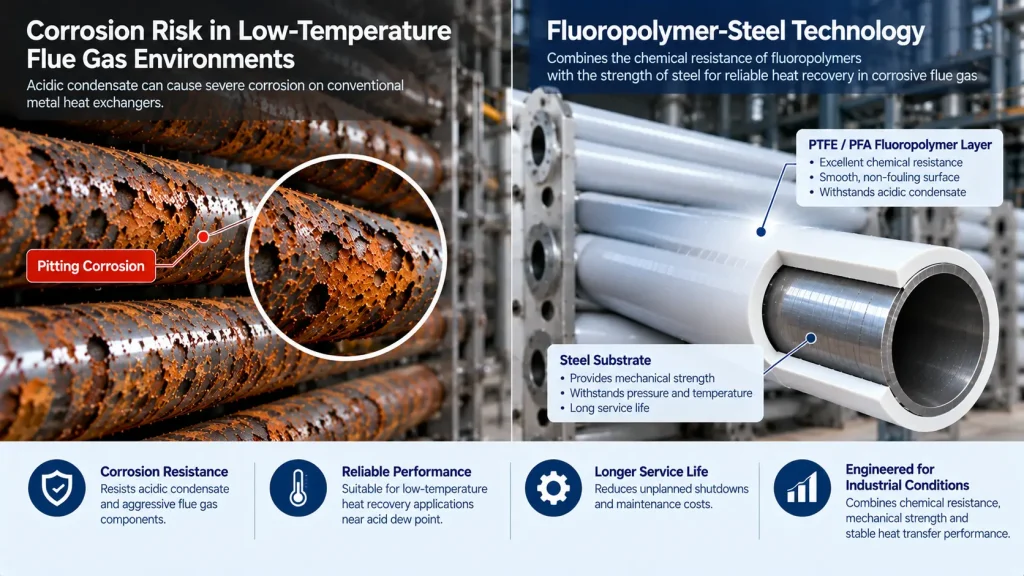
For challenging flue gas conditions, Langteng Thermal focuses on fluoropolymer-steel composite heat transfer technology.
This approach combines the structural function of steel with the chemical resistance of a fluoropolymer protective layer.
Fluoropolymers such as PTFE and PFA are known for their chemical resistance across a broad range of industrial environments.
When appropriately selected and incorporated into heat exchanger construction, a fluoropolymer barrier can help protect the underlying metal from direct contact with aggressive condensate.
This is particularly relevant where conventional exposed metal surfaces would experience unacceptable corrosion.
However, chemical compatibility must be evaluated against the actual process composition, temperature, concentration, and operating conditions.
The steel substrate contributes mechanical strength and structural support.
This allows the composite construction to combine different material functions rather than relying on a single material to provide both corrosion resistance and mechanical performance.
Fluoropolymers generally have lower thermal conductivity than metals.
For that reason, adding a protective layer introduces thermal resistance that must be considered during equipment design.
The engineering objective is not to claim that fluoropolymer materials transfer heat faster than steel.
Instead, the objective is to achieve an appropriate balance between:
In corrosive environments, protecting the heat transfer surface from premature degradation can be critical to maintaining useful equipment performance over time.
Fluoropolymer-steel composite technology may be considered for suitably engineered applications involving:
Not every application requires this construction.
For relatively clean flue gas operating safely above problematic condensation temperatures, a conventional metal heat exchanger may be sufficient and more economical.
The correct choice depends on the complete operating conditions.
| Design Consideration | Conventional Metal Heat Exchanger | Fluoropolymer-Steel Composite Heat Exchanger |
| Mechanical strength | Depends on selected metal | Supported by steel substrate |
| Thermal conductivity | Generally high for common metals | Protective layer adds thermal resistance |
| Acidic condensate exposure | May require resistant alloys or other protection | Fluoropolymer barrier can provide corrosion protection |
| Low-temperature operation | Depends on material and gas chemistry | Can be engineered for selected corrosive conditions |
| Maintenance requirements | Depend on corrosion and fouling | Depend on coating integrity, fouling, and operating conditions |
| Initial equipment cost | Varies by alloy and design | Depends on composite construction and engineering requirements |
| Lifecycle performance | Application-specific | Application-specific |
The most appropriate material should be selected based on technical compatibility and total lifecycle cost, not simply on initial equipment price.
From a manufacturer's perspective, reliable system selection begins with understanding the actual process rather than choosing equipment based only on nominal boiler capacity.
The following parameters are particularly important.
| Engineering Parameter | Why It Matters |
| Flue Gas Flow Rate | Determines the quantity of available thermal energy |
| Flue Gas Inlet Temperature | Establishes the starting thermal condition |
| Target Outlet Temperature | Influences recovery potential and condensation risk |
| Flue Gas Composition | Determines chemical compatibility and corrosion risks |
| Dust and Particulate Loading | Influences fouling and cleaning requirements |
| Heat Recovery Medium | Defines how recovered energy will be used |
| Medium Inlet and Outlet Temperatures | Establishes the available temperature driving force |
| Allowable Gas-Side Pressure Drop | Protects fan capacity and process stability |
| Annual Operating Hours | Influences economic payback |
| Installation Space | Affects equipment configuration and retrofit feasibility |
For corrosive flue gas, material selection should be performed alongside the thermal calculation—not after the heat exchanger has already been sized.
Consider an industrial boiler discharging hot flue gas while a nearby process requires warm water.
A heat recovery system can transfer part of the exhaust energy into the water circuit.
If the water inlet temperature is relatively high, a non-condensing economizer may provide a practical solution.
If colder water is available, deeper cooling and potentially condensing recovery may become feasible.
However, where the flue gas contains aggressive acid-forming components, the design must also address condensate corrosion, drainage, and downstream equipment compatibility.
The final solution therefore depends on both the thermal opportunity and the chemical environment.
Flue gas heat recovery systems help industrial facilities make better use of the energy already present in their exhaust streams.
They work by transferring heat from hot flue gas to a useful process medium, reducing fuel demand and improving overall energy utilization.
Their main benefits include lower energy costs, improved efficiency, and reduced fuel-related emissions.
However, deeper heat recovery introduces additional engineering challenges, particularly when flue gas temperatures approach conditions where corrosive condensation occurs.
For these applications, selecting suitable heat exchanger materials is essential.
Fluoropolymer-steel composite technology offers one approach to combining corrosion protection with the mechanical support required for industrial heat recovery equipment.
At Langteng Thermal, our engineering focus is on developing corrosion-resistant heat recovery equipment around actual flue gas conditions, heat transfer requirements, and installation constraints.
Whether your application involves a low-temperature economizer, flue gas condenser, or industrial air preheater, selecting the right equipment begins with accurate process data.
Contact Langteng Thermal to discuss your flue gas composition, operating temperatures, flow rates, and heat recovery objectives.

@ 2025-2026 Langteng Machinery. All Rights Reserved.