Time: Jul 6 2026 Views: 3
INTRODUCTION
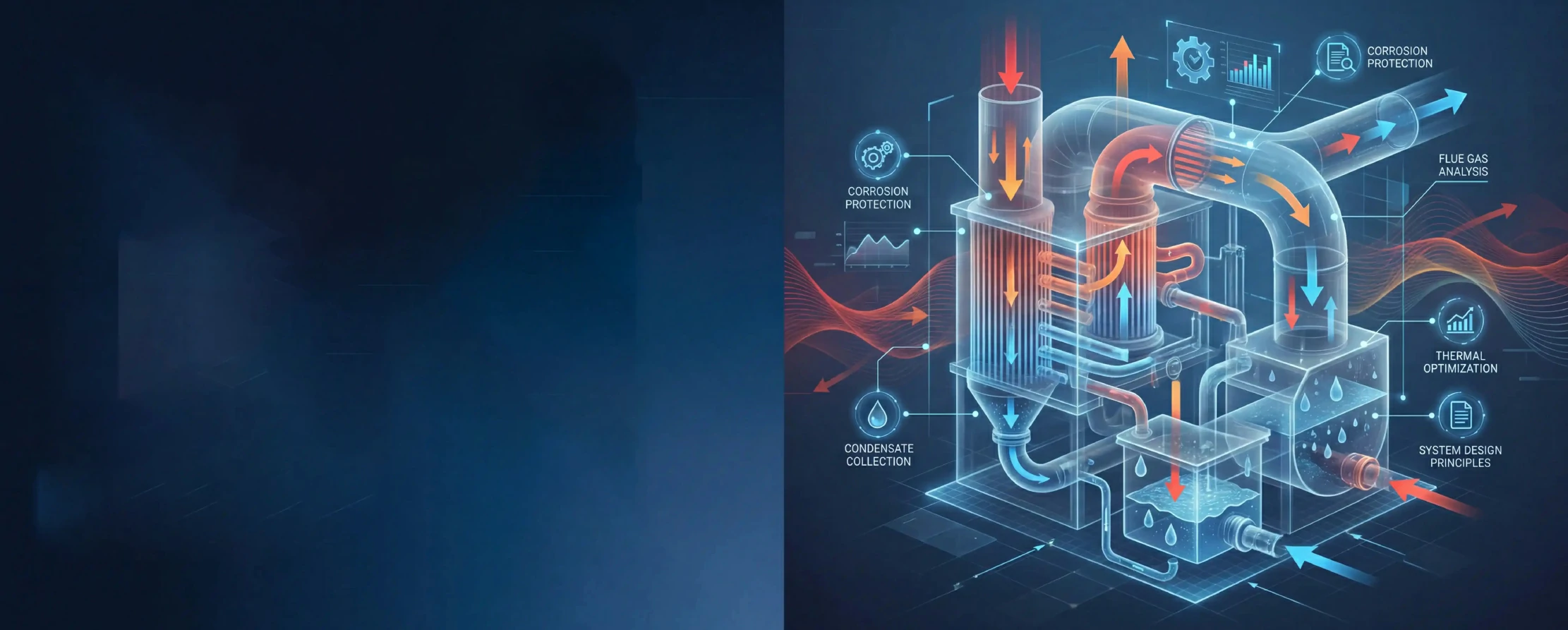
Heat exchanger system design logic defines how thermal, mechanical, and chemical constraints are integrated into a complete and reliable industrial heat recovery system.
In flue gas and industrial process applications, performance is not determined by a single heat exchanger, but by the interaction of the entire system, including:
● flow dynamics
● heat transfer behavior
● corrosion mechanisms
● pressure drop control
● material selection
● operational stability
PRINCIPLE 1 — SYSTEM INTEGRATION OVER COMPONENT OPTIMIZATION
A heat exchanger does not operate in isolation.
Its performance depends on the system in which it is installed.
Key system elements include:
● flue gas source conditions
● duct layout and flow distribution
● heat transfer modules
● condensate management
● downstream energy utilization
> System performance is defined by integration, not individual equipment efficiency.
PRINCIPLE 2 — FLUE GAS FLOW DESIGN DEFINES HEAT TRANSFER PERFORMANCE
The way gas flows through the system directly impacts:
● heat transfer efficiency
● temperature distribution
● fouling formation
● corrosion risk zones
Poor flow design leads to:
● uneven heat exchange
● localized condensation
● accelerated corrosion hotspots
Proper system design ensures uniform flow distribution across all heat transfer surfaces.
PRINCIPLE 3 — PRESSURE DROP IS A KEY ENERGY CONSTRAINT
Every heat exchanger introduces resistance to gas flow.
Excessive pressure drop results in:
● higher fan energy consumption
● reduced net system efficiency
● increased operational cost
System design must balance:
> heat transfer efficiency vs flow resistance
This balance is critical in large-scale industrial systems.
PRINCIPLE 4 — CORROSION DEFINES SYSTEM LIMITS
In low-temperature heat recovery systems, corrosion is often the primary design constraint.
When flue gas temperature approaches the acid dew point:
● acidic condensation occurs
● corrosion accelerates rapidly
● material degradation begins
Therefore, corrosion protection must be integrated into system design, not treated as a secondary consideration.
PRINCIPLE 5 — TEMPERATURE CONTROL DEFINES RECOVERY DEPTH
Heat exchanger systems aim to reduce flue gas temperature to recover energy.
However:
● lower temperature → higher efficiency
● lower temperature → higher corrosion risk
System design must define a safe operating window that maximizes energy recovery without crossing corrosion thresholds.
PRINCIPLE 6 — MATERIAL AND STRUCTURE MUST WORK TOGETHER
Heat exchanger performance depends on coordinated material and structural design.
Key material roles:
● corrosion protection layer
● mechanical load-bearing structure
● thermal transfer surface
For example:
● fluoroplastic provides chemical resistance
● steel provides structural strength
● composite systems combine both functions
> Material selection must support system-level objectives.
PRINCIPLE 7 — HEAT TRANSFER SURFACE DESIGN IS A BALANCE
Increasing heat transfer surface improves efficiency but introduces trade-offs:
● higher fouling risk
● increased pressure drop
● greater corrosion exposure
System design must balance:
● surface area
● flow velocity
● maintenance accessibility
PRINCIPLE 8 — LIFECYCLE PERFORMANCE DEFINES TRUE VALUE
Industrial systems operate over long durations.
Therefore, true performance is measured by:
● operational stability
● maintenance frequency
● degradation rate
● energy efficiency over time
> A stable system with consistent performance often outperforms a high-efficiency but unstable design.
KEY INSIGHT
Heat Exchanger Design Is a Multi-Constraint Optimization Problem
Successful system design requires balancing:
● thermal efficiency
● corrosion resistance
● mechanical stability
● pressure loss
● lifecycle cost
There is no single “optimal” parameter — only system equilibrium.
CONCLUSION
Heat exchanger system design logic is the foundation of industrial heat recovery engineering.
By integrating thermodynamics, fluid dynamics, corrosion science, and material engineering, it is possible to design systems that deliver:
● high energy recovery
● stable long-term operation
● reduced maintenance requirements
● improved lifecycle economics

@ 2025-2026 Langteng Machinery. All Rights Reserved.